
Amino acids and peptide bondsSpec B1.2.1, B1.2.2
In short
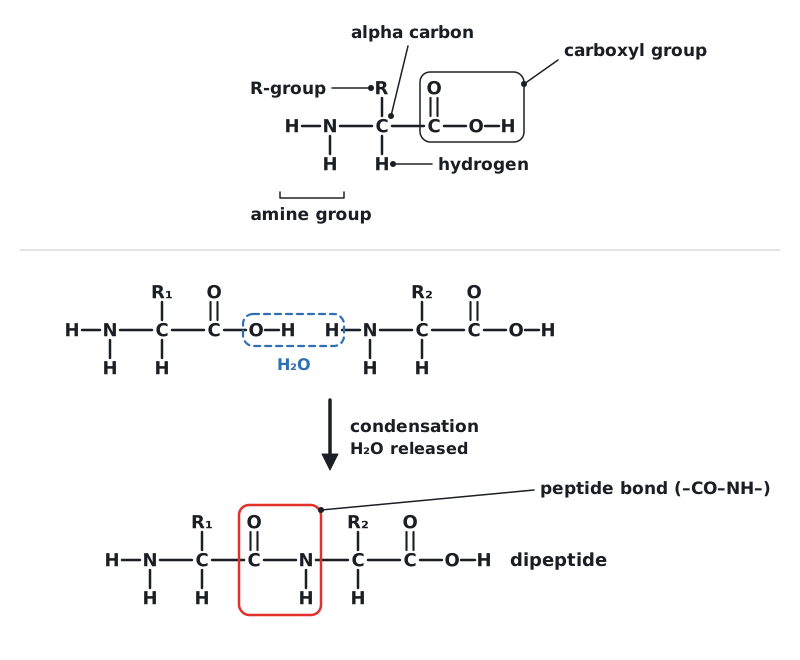
An amino acid has a central alpha carbon atom bonded to an amine group, a carboxyl group, a hydrogen atom and a variable R-group. In a condensation reaction the carboxyl group of one amino acid reacts with the amine group of another, forming a peptide bond and releasing water. Repeating this produces a polypeptide.
Proteins are made of one or more polypeptides, which are chains of amino acids. Every amino acid has the same basic structure, built around a central carbon called the alpha carbon.
- an amine group (–NH₂)
- a carboxyl group (–COOH)
- a hydrogen atom (–H)
- an R-group, which differs between the 20 amino acids
 (opens full size in a new tab)
When drawing an amino acid, show every bond to the alpha carbon and write the groups in full: H₂N–, –COOH, –H and R. Marks are lost for a missing hydrogen on the alpha carbon.
Forming dipeptides and polypeptides
The carboxyl group of one amino acid reacts with the amine group of the next in a condensation reaction. An –OH and an –H are removed as water, and a peptide bond (–CO–NH–) forms between the carbon and the nitrogen.
Further condensation reactions add amino acids one at a time to form a polypeptide. In cells this happens on ribosomes during translation. A polypeptide still has a free amine group at one end and a free carboxyl group at the other.
Build two amino acids with molecular models, remove –OH and –H to make water, then join the C and N. Drawing the dipeptide afterwards helps you place the peptide bond correctly.
Written and checked against the IB Biology SL specification · Updated October 2026