
Tissues in dicotyledonous stems and rootsSpec B3.2.9, B3.2.10
In short
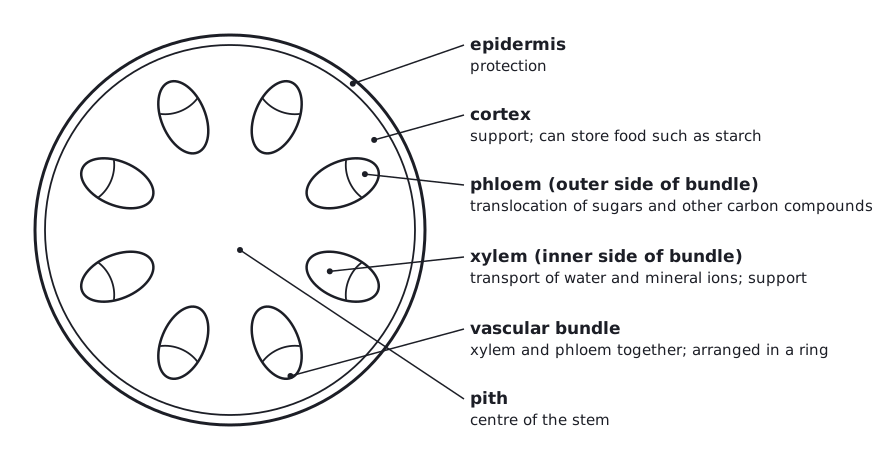
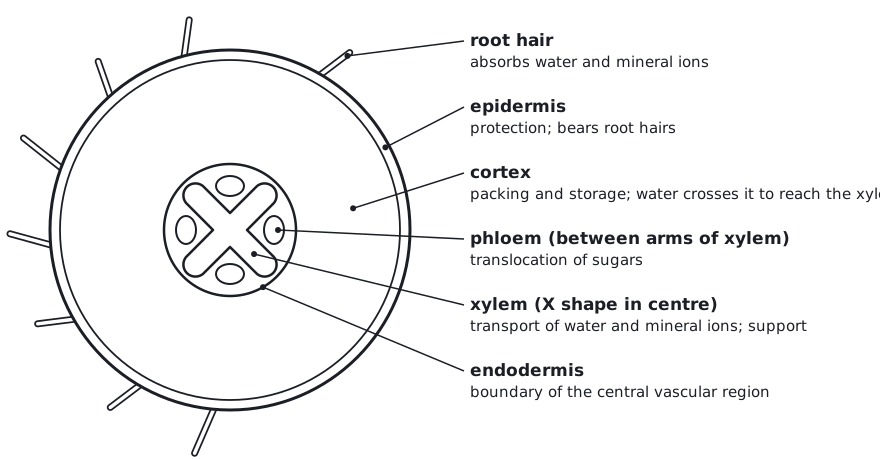
In a transverse section of a dicotyledonous stem, vascular bundles are arranged in a ring, each with phloem towards the outside and xylem towards the inside, surrounded by cortex and an outer epidermis. In a dicotyledonous root, xylem and phloem are in a central vascular region, with xylem in a star shape, surrounded by a wide cortex and epidermis.
| Tissue | Main function |
|---|---|
| Epidermis | Protective outer layer; in roots it bears root hairs that absorb water and mineral ions. |
| Cortex | Packing and support tissue between epidermis and vascular tissue; can store food such as starch; in roots water crosses it to reach the xylem. |
| Xylem | Transports water and mineral ions from roots to leaves; lignified walls give support. |
| Phloem | Transports sap containing sugars and other carbon compounds by translocation. |
| Vascular bundle | A strand of xylem and phloem together. |
Stem
- Vascular bundles are arranged in a ring near the outside of the stem.
- In each bundle, phloem is on the outside and xylem on the inside.
- Cortex lies between the epidermis and the ring of bundles; the centre of the stem is pith.
 (opens full size in a new tab)
Root
- Xylem and phloem form a central vascular region, not a ring: xylem in a star or X shape with phloem between its arms.
- The guide asks you to identify vascular bundles in the root too. In a root they are radial: the groups of xylem and phloem alternate on different radii inside one central vascular cylinder (the stele), instead of xylem and phloem sharing a bundle as in the stem.
- A wide cortex surrounds the vascular region, with the epidermis and root hairs on the outside.
- The central position of vascular tissue resists the pulling forces on a root.
 (opens full size in a new tab)
Draw plan diagrams from micrographs: outline each tissue with a single clear line, keep proportions accurate, no cells and no shading. Label the tissues the guide lists (epidermis, cortex, vascular bundles, xylem and phloem; pith in the stem) and, for the stem, annotate each label with its main function.
Quick check
What are fenestrations in capillaries?
Show answer
Pores in the capillary wall that allow particularly rapid exchange, for example in the kidney glomerulus.
How do elastic fibres in artery walls help maintain blood pressure?
Show answer
They stretch when blood is pumped in and recoil between beats, pushing blood on and keeping the pressure up.
What causes tension in the xylem?
Show answer
Loss of water by transpiration from leaf cell walls draws water out of the xylem by capillary action.
Where is xylem found in a dicotyledonous root?
Show answer
In the centre, in a star or X shape, with phloem between its arms.
Written and checked against the IB Biology SL specification · Updated October 2026