
Fundamental and realized niches, and competitive exclusionSpec B4.2.12, B4.2.13
In short
The fundamental niche is the potential of a species based on its adaptations and tolerance limits, and the realized niche is the actual extent of its niche when in competition with other species. By the competitive exclusion principle, two species cannot share the same niche indefinitely: one is eliminated, or both are restricted to part of their fundamental niche.
- Fundamental niche
- The potential niche of a species, based on its adaptations and tolerance limits, in the absence of competition.
- Realized niche
- The actual extent of a species' niche when it is in competition with other species. It is usually smaller than the fundamental niche.
Example: on rocky shores two barnacle species, Chthamalus stellatus and Semibalanus balanoides (formerly Balanus), grow at different heights. Chthamalus can survive lower on the shore when its competitor is removed, so its fundamental niche is larger than its realized niche. Where both are present, faster-growing Semibalanus crowds it out of the lower zone, and Chthamalus is restricted to the upper shore, where it tolerates drying out better.
Competitive exclusion
The competitive exclusion principle states that two species with the same niche cannot coexist indefinitely in the same place. When two species compete, there are two possible outcomes:
- Elimination of one of the competing species from the area, because the other uses the shared resources more efficiently.
- Restriction of both species to a part of their fundamental niche, so that each uses a slightly different part of the resources (their realized niches no longer overlap fully).
So each ecological niche is unique: no two species in an ecosystem occupy exactly the same niche.
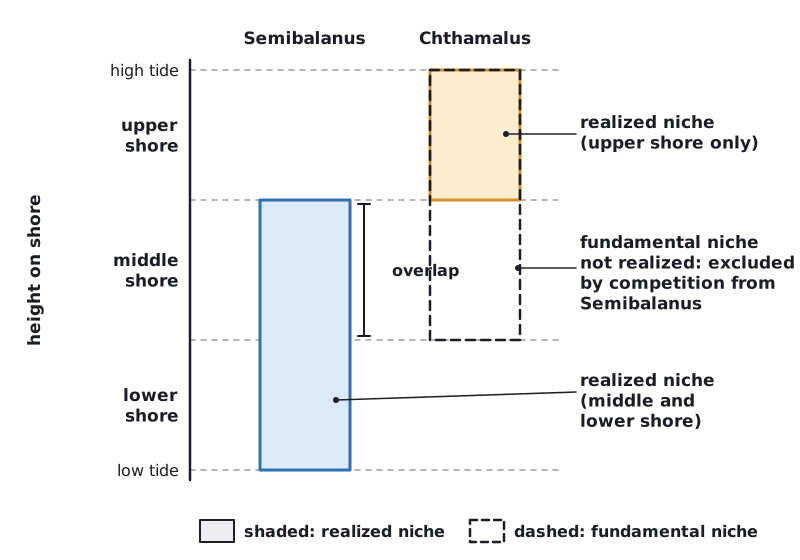 (opens full size in a new tab)
When data show a species spreading after a competitor is removed, say the species had moved from its realized niche towards its fundamental niche.
Quick check
Define ecological niche.
Show answer
The role of a species in an ecosystem, including the biotic and abiotic interactions that influence its growth, survival and reproduction.
What is a facultative anaerobe?
Show answer
An organism that can live with or without oxygen, respiring aerobically when oxygen is present and anaerobically when it is absent.
List the four stages of holozoic nutrition in order.
Show answer
Ingestion, digestion, absorption, assimilation.
Name an example of a mixotrophic protist.
Show answer
Euglena.
State two possible outcomes of competition between two species.
Show answer
One species is eliminated, or both are restricted to part of their fundamental niche.
Written and checked against the IB Biology SL specification · Updated October 2026