

Plant hormones, phototropism and gravitropismSpec 4.5.4.1
Plants produce hormones to coordinate and control growth and responses to light (phototropism) and gravity (gravitropism or geotropism).
Unequal distributions of auxin cause unequal growth rates in plant roots and shoots.
| Response | Where auxin builds up | Effect on growth | Result |
|---|---|---|---|
| Shoot growing towards light | On the shaded side of the shoot | Cells on the shaded side elongate more | The shoot bends towards the light |
| Root growing downwards | On the lower side of the root | Growth of cells on the lower side is slowed down | The root bends downwards, in the direction of gravity |
| Shoot growing upwards | On the lower side of the shoot | Cells on the lower side elongate more | The shoot bends upwards, away from gravity |
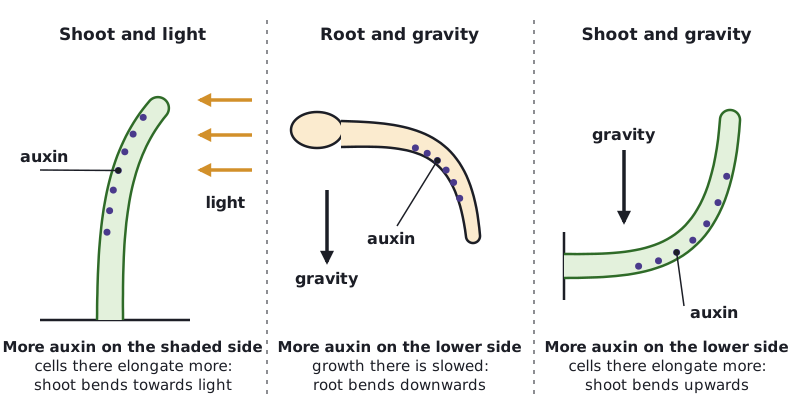 Tap to enlarge
Gibberellins and ethene
- Gibberellins are important in initiating seed germination.
- Ethene controls cell division and ripening of fruits.
You do not need to know how gibberellins and ethene work.
- Germinate seeds (for example cress) on damp cotton wool or filter paper in a dish.
- For light: place identical seedlings in a box with a slit that lets light in from one side only. Keep a control set in even light all round.
- For gravity: fix seedlings in a dish, turn the dish on its side so the roots point sideways and keep it in the dark. Keep a control set upright.
- Measure the length of the shoot (and root) with a ruler at regular intervals, and make a labelled drawing of each seedling to show the direction of growth.
- Compare the treated seedlings with the control seedlings.
- Independent variable: the direction of the light, or the position of the seedling (gravity).
- Dependent variable: the direction and length of growth.
- Control variables: the type and age of seedling, temperature and the amount of water. Keep the gravity test in the dark so light does not affect the result.
- Safety: wash your hands after handling seedlings and compost, and do not eat any seeds or seedlings.
- Typical results: shoots bend towards the light; roots bend down; shoots grow upwards even in the dark.
Uses of plant hormonesSpec 4.5.4.2
Plant growth hormones are used in agriculture and horticulture to control plant growth.
| Hormone | Use |
|---|---|
| Auxins | As weed killers; as rooting powders; for promoting growth in tissue culture |
| Ethene | In the food industry to control ripening of fruit during storage and transport |
| Gibberellins | To end seed dormancy; to promote flowering; to increase fruit size |
Using hormones as weed killers can affect biodiversity. Killing weeds helps the crop grow, but it also reduces the number of other plant species in the area, and so the animals that depend on them.
Quick check
Which hormone causes unequal growth in roots and shoots?
Show answer
Auxin.
Why does a shoot bend towards light?
Show answer
Auxin builds up on the shaded side, so cells there grow more and the shoot bends towards the light.
What do the terms phototropism and gravitropism mean?
Show answer
Phototropism is a growth response to light. Gravitropism (geotropism) is a growth response to gravity.
Higher tier Name one use of gibberellins.
Show answer
Any one of: ending seed dormancy, promoting flowering, increasing fruit size.