

Genetic inheritanceSpec 4.6.1.6
- Gamete
- A sex cell (sperm, egg or pollen) that has a single set of chromosomes.
- Chromosome
- A structure in the nucleus made of DNA, carrying many genes.
- Gene
- A small section of DNA on a chromosome that codes for a particular protein.
- Allele
- A different form of the same gene.
- Dominant
- An allele that is always expressed, even if only one copy is present.
- Recessive
- An allele that is only expressed if two copies are present (so no dominant allele is present).
- Homozygous
- Having two alleles that are the same for a trait.
- Heterozygous
- Having two alleles that are different for a trait.
- Genotype
- The alleles present for a characteristic.
- Phenotype
- How the characteristic is expressed, such as black fur.
Some characteristics are controlled by a single gene, such as fur colour in mice and red-green colour blindness in humans. Each gene may have different forms called alleles. The alleles present (the genotype) operate at a molecular level to develop characteristics that are expressed as a phenotype.
Most characteristics are the result of multiple genes interacting, rather than a single gene.
Dominant alleles are shown with a capital letter (B) and recessive alleles with the same letter in lower case (b). A black-furred mouse could be BB or Bb. A brown mouse must be bb.
Genetic crosses
A Punnett square shows the possible combinations of alleles from the gametes. Each box is equally likely, so you can use it to predict probability and ratios. Probability tells you the chance of an outcome, not what will actually happen in a small family.
Cross between two heterozygous mice
In mice, black fur (B) is dominant to brown fur (b). Two black mice, both Bb, are crossed. Show the possible offspring, the ratio of phenotypes and the probability of a brown mouse.
- Gametes from one parent: B and b. Gametes from the other parent: B and b.
- Fill in the Punnett square: BB, Bb, Bb, bb.
- Three of the four boxes contain at least one B, so they are black. One box is bb, so it is brown.
- Ratio of black : brown = 3 : 1.
- Probability of brown = 1 out of 4.
Answer: Ratio 3 black : 1 brown. The probability of a brown mouse is 1 in 4, which is 0.25 or 25%.
Using a ratio
The cross above produces 80 offspring in total. About how many would you expect to be black?
- The ratio is 3 : 1, so there are 3 + 1 = 4 parts.
- One part = 80 ÷ 4 = 20.
- Black = 3 parts = 3 × 20 = 60.
Answer: About 60 black offspring.
You must be able to complete a Punnett square diagram and extract and interpret information from genetic crosses.
Higher tier students must also be able to construct a genetic cross by Punnett square diagram from scratch and use it to make predictions using the theory of probability.
Family trees
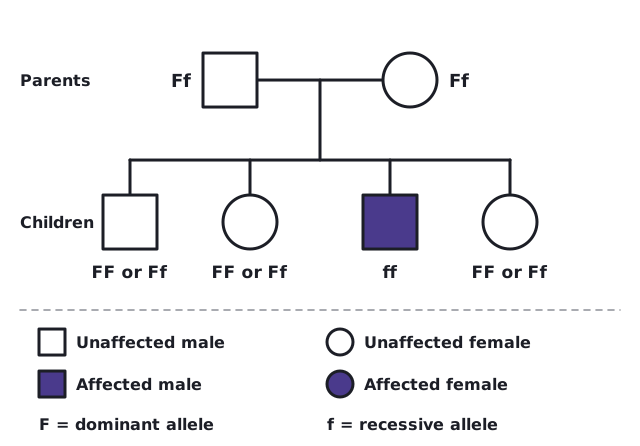
A family tree shows how a characteristic is passed through a family. Squares usually show males and circles show females, and shading shows people who have the characteristic. If two parents who do not show a characteristic have a child who does, the characteristic must be recessive, and both parents must be heterozygous.
 Tap to enlarge