

Pyramids of biomassSpec 4.7.4.2
Pyramids of biomass can be constructed to represent the relative amount of biomass in each level of a food chain. Trophic level 1 is at the bottom of the pyramid.
Each bar is narrower than the one below it, because the biomass decreases at each higher trophic level. This gives the pyramid shape.
- Draw horizontal bars, one for each trophic level, with trophic level 1 at the bottom.
- Choose a scale so that the length of each bar is proportional to the biomass of that level.
- Centre the bars on a vertical line and label each bar with the organism or level.
Constructing a pyramid
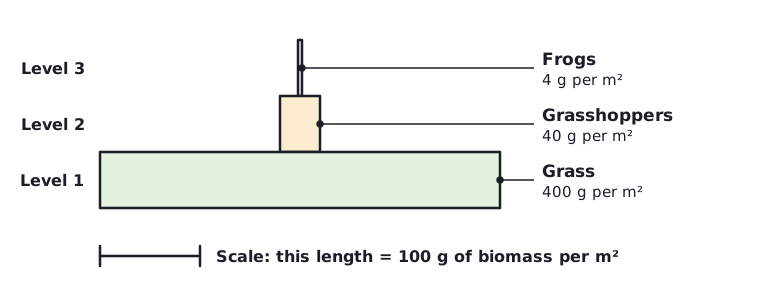
A food chain has biomass of 400 g per m² of grass, 40 g per m² of grasshoppers and 4 g per m² of frogs. Describe how to construct the pyramid using a scale of 1 mm = 4 g.
- Grass: 400 ÷ 4 = a bar 100 mm long, at the bottom.
- Grasshoppers: 40 ÷ 4 = a bar 10 mm long, above the grass.
- Frogs: 4 ÷ 4 = a bar 1 mm long, at the top.
Answer: Three centred bars of 100 mm, 10 mm and 1 mm, with grass at the bottom and frogs at the top.
 Tap to enlarge