
Book a tutor
Book a tutor

Controlling the heart rate

Note 8 of 20 · Animal tissues, organs and organ systems · Organisation

Controlling the heart rateSpec 4.2.2.2

In short

The natural resting heart rate is controlled by a group of cells in the right atrium that act as a pacemaker. If the heart rate becomes irregular, an artificial pacemaker, which is an electrical device, can be used to correct it. A common exam mistake is to say that the pacemaker is the whole heart or the brain.

The natural resting heart rate is controlled by a group of cells located in the right atrium that act as a pacemaker.
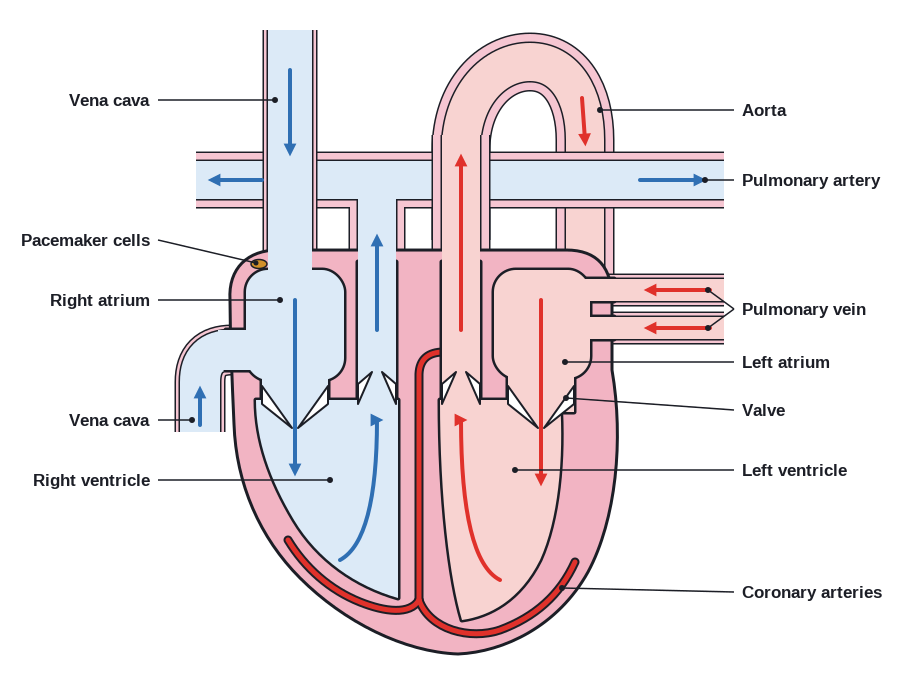
Diagram of the heart with the pacemaker cells labelled as a small group of cells in the wall of the right atrium, near where the vena cava enters. (opens full size in a new tab)
The natural pacemaker is a group of cells in the right atrium.

Sometimes the heart rate is irregular. Artificial pacemakers are electrical devices used to correct irregularities in the heart rate.

Exam tip:

Say ‘a group of cells in the right atrium’. A common mistake is to say the pacemaker is the whole heart or the brain.

Written and checked against the AQA GCSE Biology (8461) specification · Updated October 2026

Frequently asked questions

Why do enzymes denature at high temperatures?

At high temperatures the shape of the enzyme's active site changes, so the substrate no longer fits and the reaction cannot be catalysed. The enzyme is denatured, and this cannot be changed back. Below the optimum, the rate rises with temperature because particles move faster and collide more often. Enzymes are not killed, because they are not alive.

How are alveoli adapted for gas exchange?

Millions of alveoli give a very large surface area for diffusion. Their walls are one cell thick, so the diffusion distance is short. A network of capillaries carries oxygen away and brings carbon dioxide, and constant ventilation brings fresh air. Both keep a steep concentration gradient, so oxygen diffuses into the blood and carbon dioxide diffuses out quickly.

Why is the left ventricle thicker than the right?

The left ventricle has a thicker muscular wall than the right because it pumps blood all the way around the body at a higher pressure. The right ventricle only pumps blood to the lungs. Both are part of the double circulatory system, in which blood passes through the heart twice on each complete circuit.

All 5 questions on Animal tissues, organs and organ systems

Need help with this topic? Book a tutor for one-to-one lessons, online or in Dubai.