

Required practical: light intensity and the rate of photosynthesisSpec 4.4.1.2
Aim: to find how the distance of a lamp from pondweed affects the rate at which it photosynthesises.
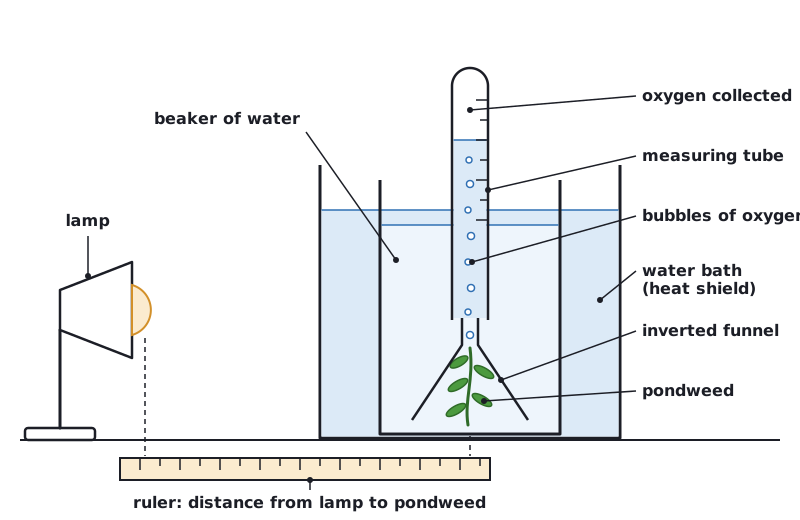
- Set up a beaker of water with a piece of pondweed and a lamp.
- Use a ruler to place the lamp a set distance from the pondweed, for example 10 cm.
- Leave the pondweed for a short time to adjust to the new light.
- Count the number of bubbles of oxygen released from the cut end of the stem in a set time (for example one minute), or collect the gas in a gas syringe or upside-down measuring tube and measure its volume.
- Repeat the count at least twice more at the same distance and calculate a mean.
- Move the lamp to a new distance (for example 20, 30, 40 and 50 cm) and repeat.
- Calculate the rate at each distance and plot a graph.
| Type | Variable |
|---|---|
| Independent (changed) | Distance of the lamp from the pondweed, which changes the light intensity |
| Dependent (measured) | Number of bubbles, or volume of oxygen, in a set time |
| Control (kept the same) | Temperature of the water, carbon dioxide concentration, the same piece of pondweed, the same lamp, time period |
- Control temperature by placing the beaker inside a larger beaker of water that acts as a heat shield, or by using a water bath. A cool LED lamp also keeps the water temperature steady.
- Control carbon dioxide by dissolving sodium hydrogencarbonate in the water.
- Do the experiment in a dim room so that light from the lamp is the main light source.
Typical results: the closer the lamp, the higher the light intensity and the more bubbles are produced. At first the rate rises steeply as the lamp moves closer. At high light intensity, the rate levels off because another factor (such as carbon dioxide concentration or temperature) becomes limiting.
Higher tier
Because the light intensity is proportional to 1 ÷ distance², you can plot rate against 1 ÷ distance² to get a straight line through the origin while light is limiting.
- Safety: keep electrical equipment (the lamp) away from water and wipe up any spills.
- Safety: lamps get hot, so do not touch them, and handle glassware carefully.
 Tap to enlarge