

SpeciationSpec 4.6.3.2
Alfred Russel Wallace independently proposed the theory of evolution by natural selection. He published joint writings with Darwin in 1858, which prompted Darwin to publish On the Origin of Species (1859) the following year.
Wallace worked worldwide gathering evidence for evolutionary theory. He is best known for his work on warning colouration in animals and his theory of speciation. More evidence over time has led to our current understanding of speciation.
The work of Darwin and Wallace had a big impact on biology. It gave a single explanation for how species change over time and how new species form, and it led to scientists collecting evidence to test the theory.
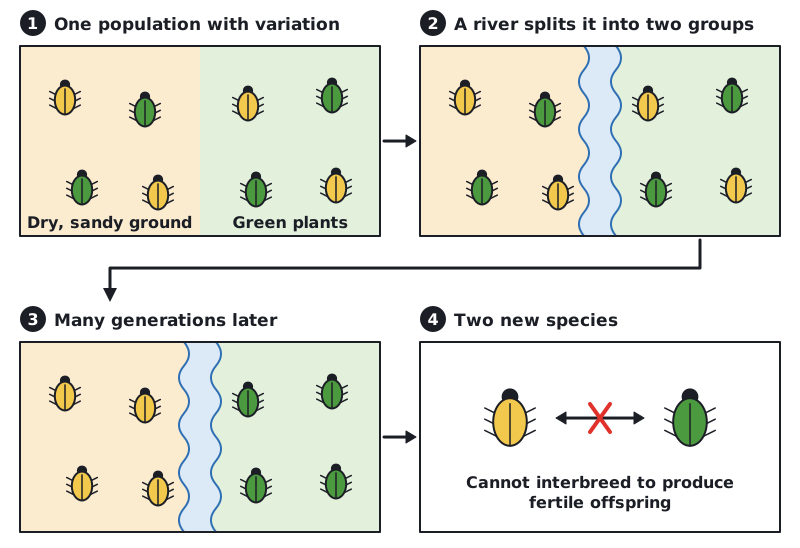
Steps that give rise to new species
- A population of one species becomes isolated (for example by a geographical barrier), so the two populations cannot interbreed.
- There is genetic variation in each population, arising from mutations.
- The two populations live in different environments, so natural selection acts differently on them. Individuals with characteristics best suited to each environment survive and breed.
- The alleles for these characteristics are passed on, so the populations change over many generations.
- Eventually the populations are so different in phenotype that they can no longer interbreed to produce fertile offspring. They are now two new species.
 Tap to enlarge