

OsmosisSpec 4.1.3.2
Water may move across cell membranes via osmosis.
- Osmosis
- The diffusion of water from a dilute solution to a concentrated solution through a partially permeable membrane.
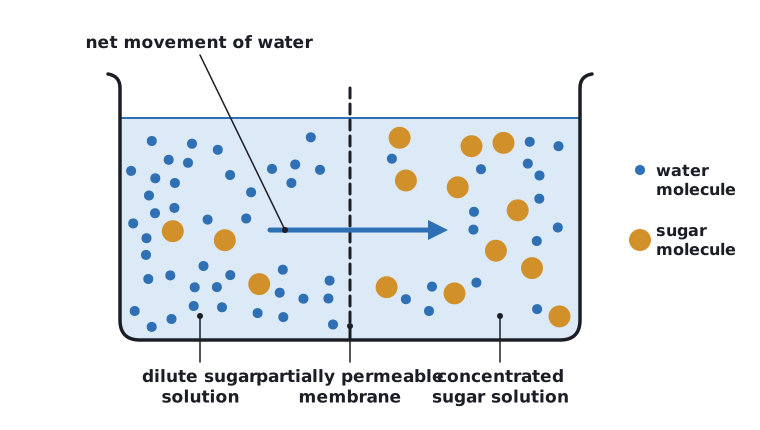 Tap to enlarge
- Cut identical cylinders of plant tissue, for example potato, using a cork borer, and trim them to the same length.
- Blot each cylinder dry and measure its mass using a balance.
- Place each cylinder in a different concentration of sugar or salt solution, including one in pure water. Use the same volume of solution in each tube.
- Leave for the same length of time at the same temperature.
- Remove the cylinders, blot them dry in the same way and measure their mass again.
- Calculate the percentage change in mass for each cylinder.
- Independent variable: the concentration of the solution.
- Dependent variable: the change in mass (as a percentage).
- Control variables: type and size of plant tissue, volume of solution, temperature, time left in the solution, how the tissue is dried.
In dilute solutions, water moves into the plant cells by osmosis and the mass increases. In concentrated solutions, water moves out of the cells and the mass decreases. Where the mass does not change, there is no net movement of water, so the solution is the same concentration as the inside of the cells.
Safety: take care when using the cork borer and scalpel, cutting on a tile and away from your hand.
Calculations and graphs
A positive answer is a gain in mass and a negative answer is a loss in mass. You should be able to use simple compound measures of rate of water uptake, for example the change in mass or volume per minute (g/min or cm³/min).
Percentage change in mass
A potato cylinder has a mass of 4.0 g at the start and 3.4 g after 30 minutes in a salt solution. Calculate the percentage change in mass and the rate of mass change in g per minute.
- Change in mass = 3.4 − 4.0 = −0.6 g.
- Percentage change = −0.6 ÷ 4.0 × 100 = −15%.
- Rate = −0.6 ÷ 30 = −0.02 g per minute.
Answer: −15% (a 15% loss in mass), a rate of −0.02 g/min.
Plot the concentration of solution on the x-axis (the independent variable) and the percentage change in mass on the y-axis. Draw a smooth line or a line of best fit through the points. The point where the line crosses the x-axis shows the concentration with no change in mass.