

The human endocrine systemSpec 4.5.3.1
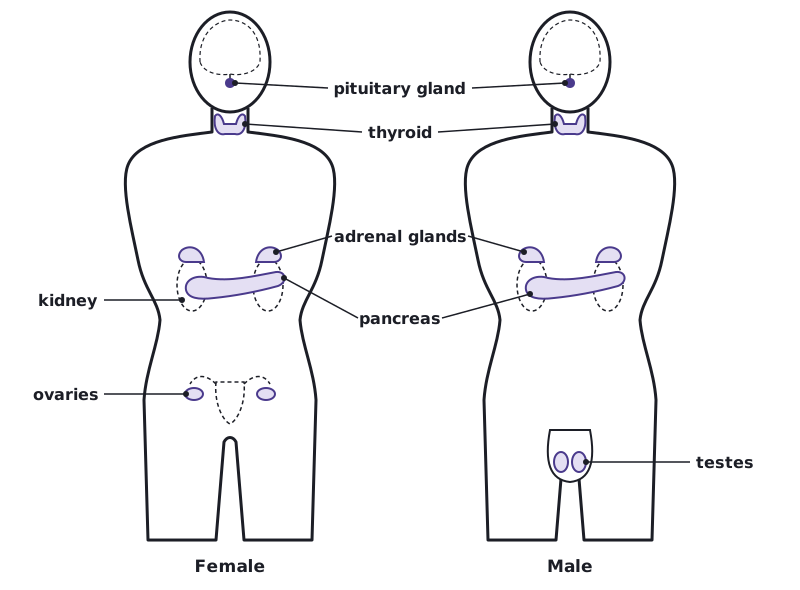
The endocrine system is made of glands which secrete chemicals called hormones directly into the bloodstream. The blood carries the hormone to a target organ where it produces an effect.
| Nervous system | Endocrine system | |
|---|---|---|
| Message carried by | Electrical impulses along neurones | Hormones (chemicals) in the blood |
| Speed of effect | Fast | Slower |
| How long the effect lasts | Short | Acts for longer |
The pituitary gland in the brain is a ‘master gland’. It secretes several hormones into the blood in response to body conditions. These hormones in turn act on other glands to stimulate other hormones to be released to bring about effects.
| Gland | Position in the body |
|---|---|
| Pituitary gland | At the base of the brain |
| Thyroid | In the neck |
| Adrenal glands | One on top of each kidney |
| Pancreas | In the abdomen, just below the stomach |
| Ovary | In the female pelvis, one on each side of the uterus |
| Testes | In the male scrotum |
Hormones from these glands that you need in this topic: the pituitary gland releases FSH and LH, the pancreas releases insulin, the ovaries release oestrogen and the testes release testosterone.
The thyroid gland releases thyroxine and the adrenal glands release adrenaline.
 Tap to enlarge
Control of blood glucose concentrationSpec 4.5.3.2
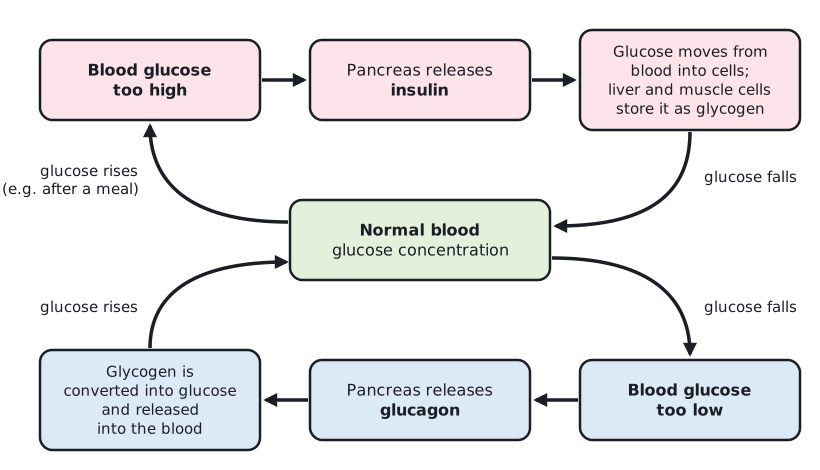
Blood glucose concentration is monitored and controlled by the pancreas.
If the blood glucose concentration is too high, the pancreas produces the hormone insulin. Insulin causes glucose to move from the blood into the cells. In liver and muscle cells excess glucose is converted to glycogen for storage.
- Blood glucose concentration rises (for example after a meal).
- The pancreas detects this and produces insulin.
- Insulin causes glucose to move from the blood into the cells.
- In the liver and muscle cells, excess glucose is converted to glycogen.
- Blood glucose concentration falls back to the normal level.
Glucagon and negative feedback
If the blood glucose concentration is too low, the pancreas produces the hormone glucagon. Glucagon causes glycogen to be converted into glucose and released into the blood.
Insulin and glucagon work against each other in a negative feedback cycle. When one hormone brings the glucose level back to normal, the pancreas stops releasing it. This keeps blood glucose near the normal level.
| Insulin | Glucagon | |
|---|---|---|
| Released when blood glucose is | Too high | Too low |
| Effect on glucose | Glucose moves from blood into cells | Glycogen is converted into glucose and released into the blood |
| Effect on blood glucose | Falls | Rises |
 Tap to enlarge
Type 1 and Type 2 diabetesSpec 4.5.3.2
Type 1 diabetes is a disorder in which the pancreas fails to produce sufficient insulin. It is characterised by uncontrolled high blood glucose levels and is normally treated with insulin injections.
In Type 2 diabetes the body cells no longer respond to insulin produced by the pancreas. A carbohydrate controlled diet and an exercise regime are common treatments. Obesity is a risk factor for Type 2 diabetes.
| Type 1 | Type 2 | |
|---|---|---|
| Cause | Pancreas fails to produce sufficient insulin | Body cells no longer respond to the insulin produced by the pancreas |
| Blood glucose | Uncontrolled high levels | High levels |
| Treatment | Insulin injections | Carbohydrate controlled diet and an exercise regime |
| Link to obesity | – | Obesity is a risk factor |
Interpreting graphs
You may be given graphs showing blood glucose over time for a person with diabetes and a person without. In a person without diabetes, blood glucose rises after a meal and then falls back to the normal level as insulin is released. In a person with Type 1 diabetes who has not taken insulin, the glucose rises higher and stays high or falls much more slowly. If insulin is injected, the glucose falls.
Reading a glucose graph
One hour after a meal, blood glucose was 9 units in a person without diabetes and 15 units in a person with untreated Type 1 diabetes. Two hours after the meal the values were 5 units and 13 units. Compare how the two people’s blood glucose changed.
- Find the change for each person: without diabetes 9 → 5, a fall of 4 units; Type 1 15 → 13, a fall of 2 units.
- The person without diabetes ends back at the normal level; the person with diabetes remains high.
- Explain: the person without diabetes makes enough insulin, so glucose moves into cells and is stored as glycogen. The person with Type 1 diabetes does not make enough insulin.
Answer: Both fell, but the person without diabetes fell more and returned to a lower level because their pancreas produces insulin. The person with Type 1 diabetes stayed high.
Obesity increases the risk of Type 2 diabetes, so questions may ask you to evaluate information on obesity and diabetes and make recommendations. Think about social and ethical issues as well as the science, for example the cost to health services and whether people should be encouraged to change their diet.
Water balance and the effect of osmosis on cellsSpec 4.5.3.3Triple only
The body loses water in several ways.
- Water leaves the body via the lungs during exhalation.
- Water, ions and urea are lost from the skin in sweat.
- Excess water, ions and urea are removed via the kidneys in the urine.
There is no control over water, ion or urea loss by the lungs or skin. Only the kidneys can adjust the amounts lost, which is why they are central to controlling the water level.
Effect of osmotic changes on cells
Water moves into and out of cells by osmosis. If body cells lose or gain too much water by osmosis they do not function efficiently. If the fluid around the cells is too dilute, water moves into the cells; if it is too concentrated, water moves out of the cells.
The kidneys and ureaSpec 4.5.3.3Triple only
The kidneys produce urine by filtration of the blood and selective reabsorption of useful substances such as glucose, some ions and water. The waste urea and the excess water and ions leave in the urine.
- Blood is filtered in the kidney. Water, glucose, ions and urea pass out of the blood.
- Useful substances are selectively reabsorbed back into the blood: all of the glucose, some ions and some water.
- The rest, including urea, excess ions and excess water, passes out as urine.
You do not need to know the other parts of the urinary system, the structure of the kidney or the structure of a nephron.
| Substance | Blood before filtration | Fluid after filtration | Urine |
|---|---|---|---|
| Glucose | 5 | 5 | 0 |
| Ions | 9 | 9 | 12 |
| Urea | 2 | 2 | 60 |
This kind of table can be shown as a bar chart. The glucose bar drops to zero in urine because all of it is reabsorbed. The urea bar is much higher in urine because water is reabsorbed while urea is not.
Excess amino acids and urea
The digestion of proteins from the diet results in excess amino acids which need to be excreted safely. In the liver, these amino acids are deaminated to form ammonia. Ammonia is toxic and so it is immediately converted to urea for safe excretion.
ADH and water levelSpec 4.5.3.3Triple onlyHigher tier
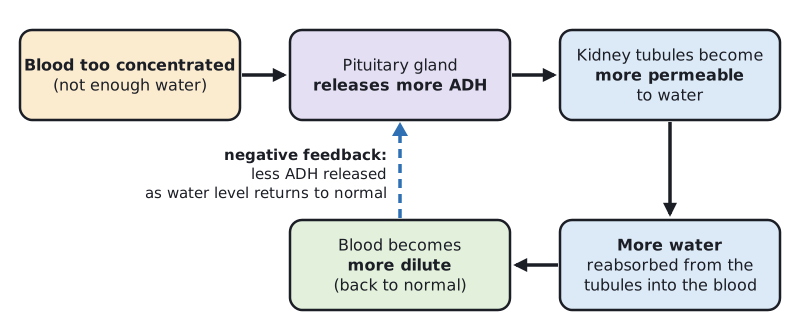
The water level in the body is controlled by the hormone ADH, which acts on the kidney tubules. ADH is released by the pituitary gland when the blood is too concentrated. It causes more water to be reabsorbed back into the blood from the kidney tubules. It does this by making the kidney tubules more permeable to water.
| Blood too concentrated (not enough water) | Blood too dilute (too much water) | |
|---|---|---|
| ADH released by pituitary | More | Less |
| Permeability of kidney tubules to water | Increases | Decreases |
| Water reabsorbed into the blood | More | Less |
| Urine | Small volume, concentrated | Large volume, dilute |
This is controlled by negative feedback: when the water level returns to normal, less ADH is released.
 Tap to enlarge
Kidney failure: dialysis and transplantSpec 4.5.3.3Triple only
People who suffer from kidney failure may be treated by organ transplant or by using kidney dialysis.
How dialysis works
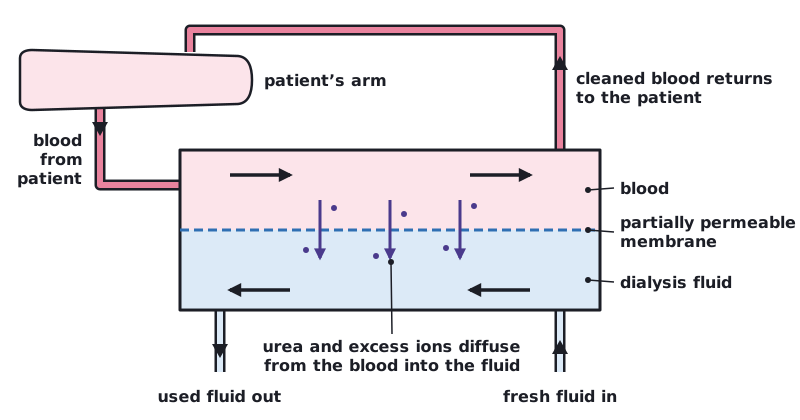
- Blood from the patient flows into a dialysis machine.
- The blood flows next to a partially permeable membrane. On the other side is dialysis fluid.
- Urea and excess ions diffuse from the blood into the dialysis fluid. Glucose and other useful substances stay in the blood, because the dialysis fluid contains these at the same concentration as normal blood.
- The cleaned blood returns to the patient.
 Tap to enlarge
| Dialysis | Kidney transplant | |
|---|---|---|
| Advantages | No need to wait for a donor; no risk of rejection | A long-term treatment; the patient is free from regular dialysis sessions and diet is less restricted |
| Disadvantages | Must be repeated regularly and takes several hours each time; diet and fluid intake must be controlled; expensive over a long time | Donor kidneys are in short supply; the body may reject the new kidney, so the patient must take drugs to prevent rejection; surgery has risks |
Hormones in human reproductionSpec 4.5.3.4
During puberty, reproductive hormones cause secondary sex characteristics to develop.
| Hormone | Made by | Role |
|---|---|---|
| Oestrogen | The ovary | The main female reproductive hormone |
| Testosterone | The testes | The main male reproductive hormone. It stimulates sperm production |
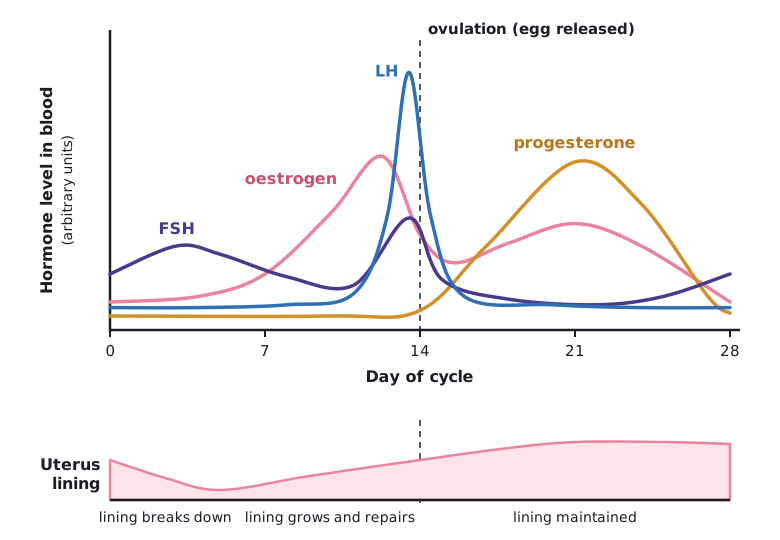
At puberty eggs begin to mature in the ovaries, and one is released approximately every 28 days. This is called ovulation.
Hormones in the menstrual cycle
| Hormone | Role in the menstrual cycle |
|---|---|
| Follicle stimulating hormone (FSH) | Causes maturation of an egg in the ovary |
| Luteinising hormone (LH) | Stimulates the release of the egg |
| Oestrogen and progesterone | Involved in maintaining the uterus lining |
How the hormones interact
- FSH is released by the pituitary gland. It causes an egg to mature in the ovary. It also stimulates the ovary to release oestrogen.
- Oestrogen causes the lining of the uterus to grow and repair. It inhibits the release of FSH. When oestrogen reaches a high level it stimulates the pituitary gland to release a surge of LH.
- LH stimulates the release of the egg (ovulation), around the middle of the cycle.
- Progesterone maintains the lining of the uterus. It inhibits the release of FSH and LH.
- If progesterone falls, the uterus lining breaks down and the next cycle starts.
 Tap to enlarge
Reading a hormone graph
A graph shows LH peaking sharply at day 14, and progesterone rising to its highest level at day 21 and falling by day 28. State what happens at day 14 and explain what the fall in progesterone at day 28 causes.
- The LH peak at day 14 matches ovulation: LH stimulates the release of the egg.
- Progesterone helps to maintain the uterus lining.
- When progesterone falls, the lining can no longer be maintained.
Answer: An egg is released at day 14. The fall in progesterone at day 28 causes the uterus lining to break down.
ContraceptionSpec 4.5.3.5
Fertility can be controlled by a variety of hormonal and non-hormonal methods of contraception.
| Method | Type | How it works |
|---|---|---|
| Oral contraceptives | Hormonal | Contain hormones which inhibit FSH production so that no eggs mature |
| Injection, implant or skin patch | Hormonal | Slow release of progesterone to inhibit the maturation and release of eggs for a number of months or years |
| Barrier methods (condoms, diaphragms) | Non-hormonal | Prevent the sperm reaching an egg |
| Intrauterine devices | Hormonal or non-hormonal | Prevent the implantation of an embryo, or release a hormone |
| Spermicidal agents | Non-hormonal | Kill or disable sperm |
| Abstaining from intercourse when an egg may be in the oviduct | Non-hormonal | Sperm cannot meet an egg |
| Surgical methods (male and female sterilisation) | Non-hormonal | A permanent operation that stops sperm or eggs from meeting |
Evaluating methods
- How effective it is when used correctly.
- Whether it can have side effects (hormonal methods can).
- Whether it is reversible. Sterilisation is permanent; the others are not.
- Whether it also protects against sexually transmitted infections. Condoms do; hormonal methods do not.
- How easy it is to use correctly, and how often it must be used or replaced.
Some issues around contraception cannot be answered by science alone. Personal, social, economic and religious views also affect whether and how people use contraception.
The use of hormones to treat infertilitySpec 4.5.3.6Higher tier
Hormones are used in modern reproductive technologies to treat infertility. A ‘fertility drug’ contains FSH and LH given to a woman. She may then become pregnant in the normal way.
In vitro fertilisation (IVF)
- The mother is given FSH and LH to stimulate the maturation of several eggs.
- The eggs are collected from the mother and fertilised by sperm from the father in the laboratory.
- The fertilised eggs develop into embryos.
- At the stage when they are tiny balls of cells, one or two embryos are inserted into the mother’s uterus (womb).
Evaluating fertility treatment
Fertility treatment gives a woman the chance to have a baby of her own. However:
- it is very emotionally and physically stressful
- the success rates are not high
- it can lead to multiple births, which are a risk to both the babies and the mother.
Adrenaline, thyroxine and negative feedbackSpec 4.5.3.7Higher tier
Adrenaline
Adrenaline is produced by the adrenal glands in times of fear or stress. It increases the heart rate and boosts the delivery of oxygen and glucose to the brain and muscles, preparing the body for ‘flight or fight’.
Thyroxine
Thyroxine from the thyroid gland stimulates the basal metabolic rate. It plays an important role in growth and development.
Negative feedback
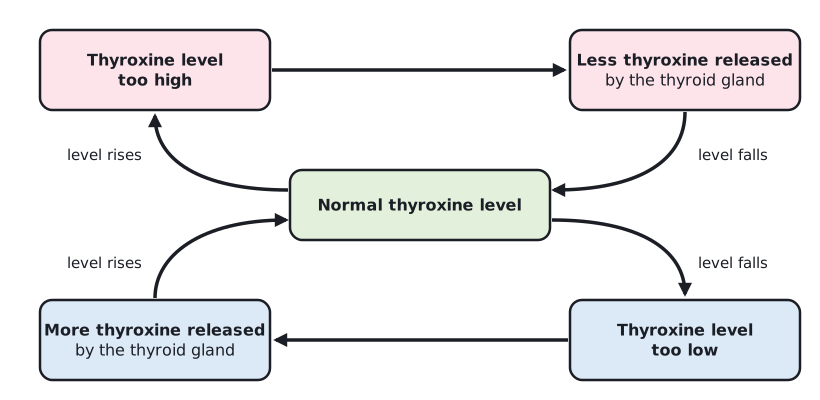
Thyroxine levels are controlled by negative feedback. If the thyroxine level in the blood becomes too high, less thyroxine is released, so the level falls. If it becomes too low, more is released, so the level rises. A change in the level is reversed to bring it back to normal.
 Tap to enlarge
Quick check
What is a hormone?
Show answer
A chemical secreted by a gland directly into the bloodstream, which acts on a target organ.
Which hormone lowers blood glucose concentration, and where is it made?
Show answer
Insulin, made in the pancreas.
Compare the cause of Type 1 and Type 2 diabetes.
Show answer
Type 1: the pancreas fails to produce enough insulin. Type 2: the body cells no longer respond to insulin.
Name the hormone that causes the release of the egg.
Show answer
Luteinising hormone (LH).
Give two non-hormonal methods of contraception.
Show answer
Any two of: condoms, diaphragms, spermicidal agents, abstaining, surgical sterilisation (non-hormonal intrauterine devices also accepted).