
Stem cells and potencySpec 3.17
In short
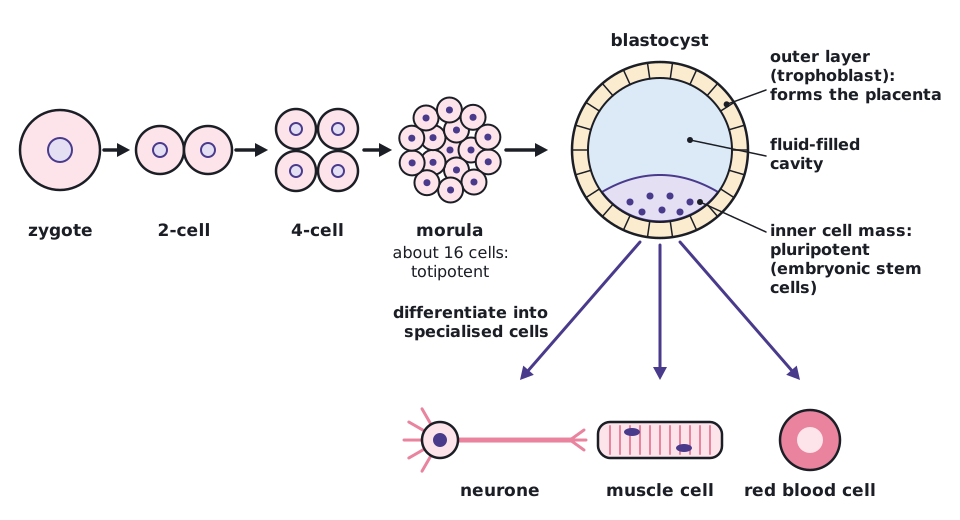
A stem cell is an undifferentiated cell that can divide by mitosis and differentiate into specialised cells. Totipotent cells can differentiate into any cell type, including the cells of the placenta, and form a whole organism. Pluripotent cells can form any cell type in the body but not extra-embryonic tissues. The morula is a solid ball of cells and the blastocyst is a hollow ball.
- Stem cell
- An undifferentiated cell that can divide by mitosis to produce more stem cells and can differentiate into specialised cell types.
- Totipotent
- Able to differentiate into any type of cell, including the cells of the extra-embryonic tissues such as the placenta, so can form a complete organism.
- Pluripotent
- Able to differentiate into almost any type of cell in the body, but not extra-embryonic tissues, so cannot form a complete organism.
- Morula
- A solid ball of about 16 cells formed by early cell divisions (cleavage) of the zygote.
- Blastocyst
- A hollow ball of cells with a fluid-filled cavity, an outer layer of cells that forms the placenta, and an inner cell mass of pluripotent cells.
After fertilisation, the zygote divides repeatedly by mitosis, without growing, to form a morula. Its cells are totipotent at first. Further divisions produce a blastocyst: the outer layer (the trophoblast) forms the placenta and the inner cell mass becomes the embryo. The cells of the inner cell mass are pluripotent. They are known as embryonic stem cells and can be collected and grown in a culture to make specialised cells.
 (opens full size in a new tab)
The difference to remember: totipotent cells can form any cell including the placenta (the whole organism); pluripotent cells can form any body cell but not the placenta.
Written and checked against the Edexcel International AS Level Biology (XBI11) specification · Updated October 2026