
Reproductive isolation and the formation of new species

Plant Structure and Function, Biodiversity and Conservation · Niche, allele frequency and conservation · note 3 of 4

Reproductive isolation and the formation of new speciesSpec 4.20(iii)

In short

When populations of the same species become reproductively isolated, no gene flow occurs between them. Mutation and natural selection, acting in different environments, cause their allele frequencies to diverge. Eventually their members can no longer interbreed to produce fertile offspring, so they are different species.

Reproductive isolation means that two populations can no longer exchange genes, so their gene pools become separate. It can be caused by:

  • geographical barriers, such as a mountain range, river or sea (a population is divided into two)
  • ecological or seasonal barriers, such as flowering or breeding at different times
  • behavioural barriers, such as different courtship songs or displays that stop mating
  1. A population is split into two (or two populations stop interbreeding).
  2. There is no gene flow between them.
  3. Mutations occur independently in each population, creating different alleles.
  4. If the environments differ, natural selection favours different alleles in each population.
  5. Allele frequencies in the two gene pools become increasingly different.
  6. Eventually members of the two populations cannot interbreed to produce fertile offspring. A new species has formed (speciation).
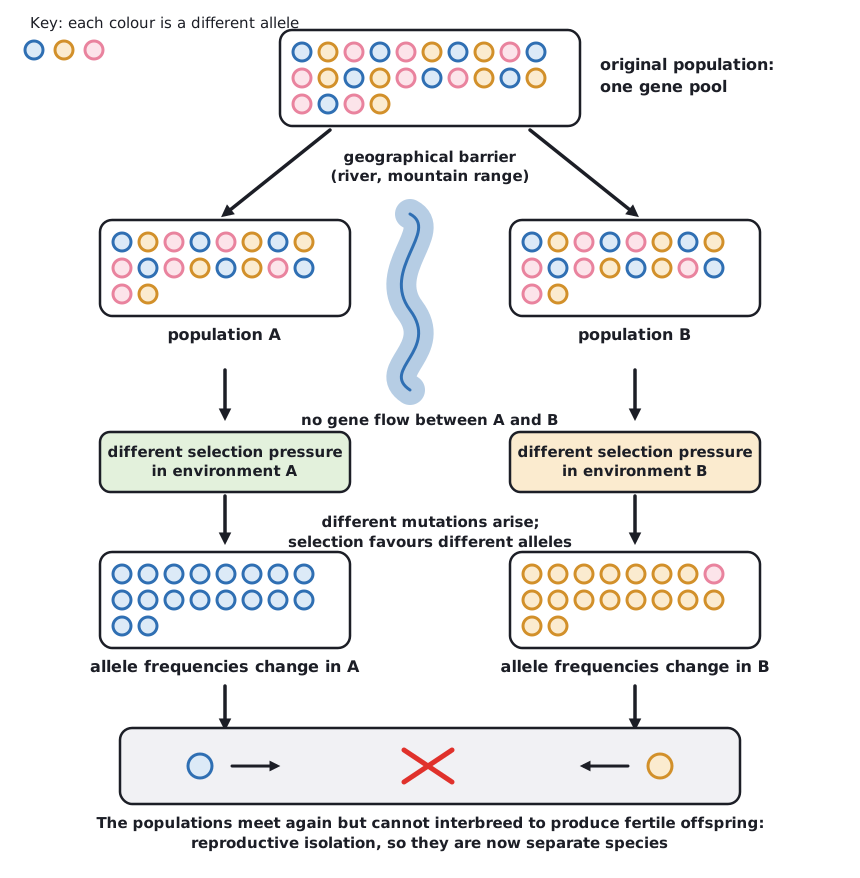
Flow diagram of allopatric speciation: one population is split by a geographical barrier, different selection pressures and mutations change allele frequencies in each gene pool, and the populations can no longer interbreed when they meet again. (opens full size in a new tab)
Allopatric speciation: geographical isolation is followed by different selection pressures and, eventually, reproductive isolation.
Exam tip:

Include all of: isolation, no gene flow, different mutations, different selection pressures, change in allele frequency, and finally the inability to interbreed to produce fertile offspring.

Written and checked against the Edexcel International AS Level Biology (XBI11) specification · Updated October 2026

Frequently asked questions

What is a niche in biology?

A niche is the role of a species within its habitat: how it obtains food and other resources, the abiotic conditions it tolerates and how it interacts with other species. Each species has its own niche, and species with very similar niches compete, so one may be excluded.

What are behavioural, anatomical and physiological adaptations?

Behavioural adaptations are how an organism acts, such as hibernation or migration. Anatomical adaptations are structural features, such as the rolled leaves of marram grass. Physiological adaptations are internal processes, such as a kangaroo rat producing concentrated urine. All of them increase survival and reproduction in the environment.

How do you use the Hardy-Weinberg equation?

Find q² from the frequency of the homozygous recessive phenotype, take the square root to get q, then calculate p = 1 − q. Use p² for homozygous dominant and 2pq for heterozygous. If later generations differ from the predicted frequencies, allele frequencies are changing.

All 5 questions on Niche, allele frequency and conservation