
Cell wall structure, secondary thickening and plant fibresSpec 4.4
In short
Cellulose microfibrils in the cell wall are laid down in layers at different angles, giving strength in all directions. Secondary thickening adds extra cellulose and lignin inside the wall of xylem vessels and sclerenchyma fibres. This makes them rigid, waterproof and strong, properties that humans exploit in fibres and timber.
The primary cell wall
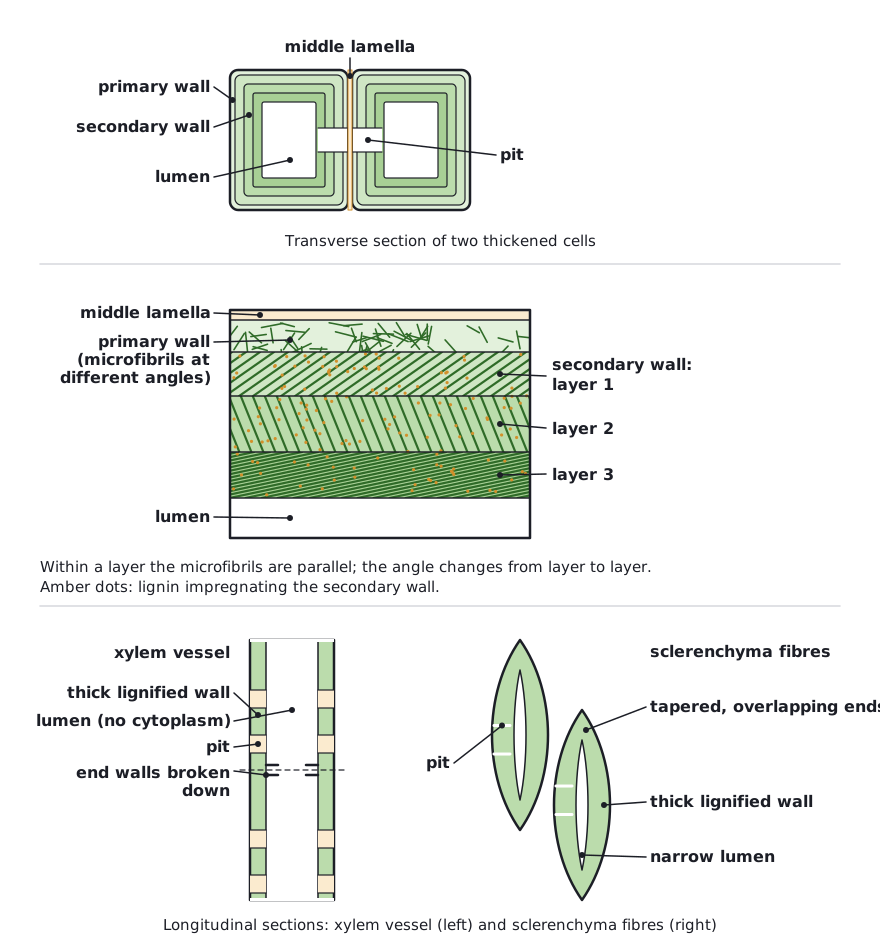
In a growing cell, cellulose microfibrils are laid down in the primary cell wall in layers, with the microfibrils running at different angles. They are held in a matrix of other polysaccharides. This arrangement resists forces from every direction, including the outward pressure of the turgid cell, while the wall remains flexible enough to allow growth.
Secondary thickening
In some cells, extra layers are added on the inside of the primary wall after the cell has stopped growing. This is secondary thickening. The new layers contain cellulose microfibrils, and in xylem vessels and sclerenchyma fibres they are impregnated with lignin, a rigid, waterproof polymer. The cell contents then die, leaving a dead, hollow cell with a strong wall.
| Tissue | Wall features | Physical properties |
|---|---|---|
| Xylem vessels | Thick secondary walls with cellulose and lignin, in rings, spirals or almost continuous layers with pits left unthickened. No end walls between vessel elements. | Lignin makes the wall waterproof, so water does not leak out. The thick, rigid wall resists collapse under the negative pressure (tension) caused by transpiration pull and gives the stem support. Pits allow sideways movement of water. |
| Sclerenchyma fibres | Very long, narrow cells with tapered ends, overlapping their neighbours. Thick, heavily lignified secondary walls built of layers of parallel cellulose microfibrils; in the thickest layer the microfibrils run almost along the length of the cell. Dead at maturity with a narrow lumen. | Very high tensile strength and some flexibility, so they support the plant and resist bending and stretching. |
Properties exploited by humans
The long cells and tightly bound microfibrils of sclerenchyma fibres make plant fibres strong, flexible and light. Humans extract them from stems and leaves, for example flax, hemp, jute and sisal, to make rope, string, textiles, paper, packaging and fibre-reinforced composite materials. Xylem tissue in wood is used for timber because its thick lignified walls are strong in compression and bending.
 (opens full size in a new tab)
Link structure to property to use: "microfibrils in layers and lignin give high tensile strength, so fibres can be used for rope".
Quick check
Name the membrane that surrounds the plant vacuole.
Show answer
The tonoplast.
State the function of plasmodesmata.
Show answer
They are channels through cell walls, lined by the cell surface membrane, that link the cytoplasm of adjacent cells and allow substances and signals to pass between them.
Which type of glucose is cellulose made from?
Show answer
β-glucose, with alternate units rotated through 180°, joined by β-1,4 glycosidic bonds.
Why does amylopectin release glucose faster than amylose?
Show answer
It is branched, so it has many free ends where enzymes can hydrolyse glycosidic bonds at the same time.
Name the polymer in secondary walls that makes them waterproof and rigid.
Show answer
Lignin.
Written and checked against the Edexcel International AS Level Biology (XBI11) specification · Updated October 2026