
Starch and celluloseSpec 4.3
In short
Starch is a storage polysaccharide made of α-glucose, and cellulose is a structural polysaccharide made of β-glucose. Hydrogen bonds between many parallel cellulose chains form strong microfibrils. Starch is compact and insoluble, so it stores glucose without affecting water potential, while cellulose resists stretching.
Both starch and cellulose are polysaccharides made by condensation reactions that join glucose monomers with glycosidic bonds. They differ in the type of glucose, the shape of the molecule and therefore the function.
Starch
Starch is the main energy store in plants and is made of α-glucose units. It is a mixture of two polysaccharides.
- Amylose: unbranched chain joined by α-1,4 glycosidic bonds. The chain coils into a helix, which makes it very compact.
- Amylopectin: α-1,4 chains with α-1,6 glycosidic bonds that make branches. Many free ends allow enzymes to hydrolyse it quickly, releasing glucose for respiration.
Starch is a good storage molecule because it is insoluble, so it does not change the water potential of the cell or leave the cell. It is also compact, so a lot of glucose is stored in a small space, and it is easily hydrolysed to α-glucose when energy is needed.
Cellulose
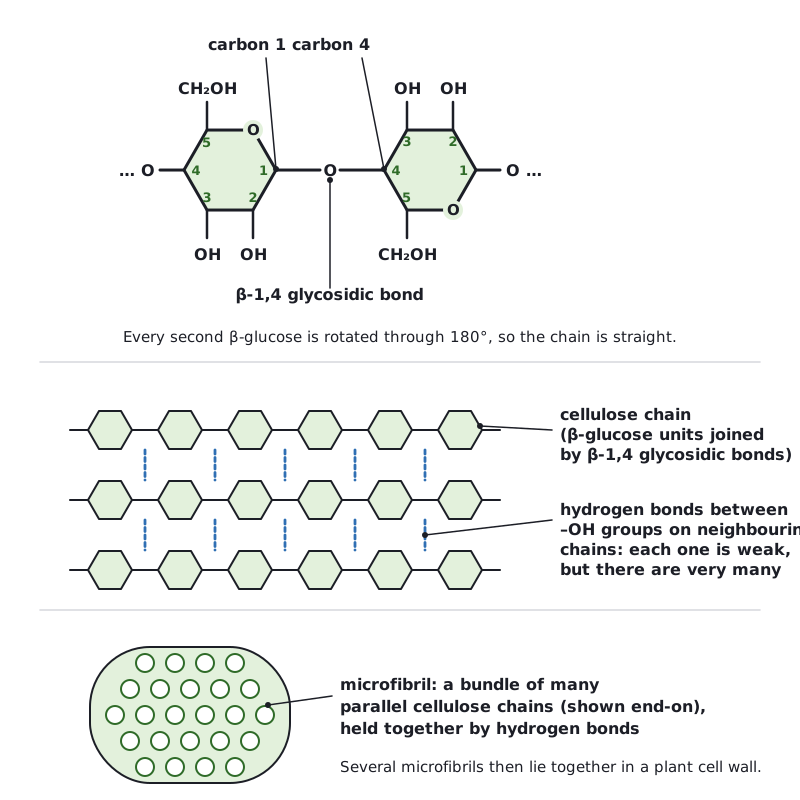
Cellulose is the main component of plant cell walls and is made of β-glucose units. In β-glucose the –OH on carbon 1 is above the ring. To form a β-1,4 glycosidic bond, every other glucose unit must be rotated through 180°. This gives a long, straight, unbranched chain.
- Straight cellulose chains lie side by side.
- Many hydrogen bonds form between the –OH groups on adjacent chains. Each bond is weak, but there are very many of them, so together they are strong.
- Many chains held side by side in a bundle form a microfibril.
- Microfibrils group into larger fibres. These have very high tensile strength and resist being pulled apart.
| Feature | Starch | Cellulose |
|---|---|---|
| Monomer | α-glucose | β-glucose |
| Glycosidic bonds | α-1,4 (and α-1,6 in amylopectin) | β-1,4 only |
| Shape | Helical (amylose) or branched (amylopectin) | Straight, unbranched chains |
| Hydrogen bonds between chains | Few: the amylose helix is held by hydrogen bonds within the chain, not between chains | Yes, forming microfibrils |
| Function | Energy store | Structural: strengthens the cell wall |
 (opens full size in a new tab)
Do not say "cellulose is strong because it has strong bonds". Each hydrogen bond is weak. Strength comes from the very large number of hydrogen bonds between parallel chains.
Written and checked against the Edexcel International AS Level Biology (XBI11) specification · Updated October 2026