
Translation, tRNA and ribosomesSpec 2.13
In short
Translation is the synthesis of a polypeptide at a ribosome. Messenger RNA codons are matched by the anticodons of transfer RNA molecules, each carrying a specific amino acid, so amino acids are joined by peptide bonds in the order the mRNA specifies. Translation starts at a start codon and finishes at a stop codon.
Translation takes place at a ribosome in the cytoplasm. A ribosome is made of ribosomal RNA (rRNA) and protein. Transfer RNA (tRNA) is a single strand of RNA folded into a clover-leaf shape. At one end it carries a specific amino acid; at the other end it has an anticodon, three bases that are complementary to a codon on mRNA.
- The ribosome attaches to the mRNA and moves along it to the start codon (AUG). The tRNA with the complementary anticodon (UAC) and its amino acid (methionine) binds to the start codon.
- A second tRNA, with the anticodon complementary to the next codon, binds. The ribosome holds two tRNAs at a time.
- A peptide bond forms between the two amino acids, by a condensation reaction, and the first tRNA is released to pick up another amino acid.
- The ribosome moves along the mRNA by one codon (three bases) and the next tRNA binds. The polypeptide chain gets longer one amino acid at a time.
- This continues until the ribosome reaches a stop codon (UAA, UAG or UGA). No tRNA matches a stop codon, so translation ends and the polypeptide is released.
| Molecule | Structure | Role |
|---|---|---|
| mRNA | Single strand; sequence of codons. | Carries the genetic code from DNA to the ribosome. |
| tRNA | Folded single strand with an anticodon and an amino acid binding site. | Brings a specific amino acid to the ribosome and matches its anticodon with the mRNA codon. |
| Ribosome | rRNA and protein, two subunits. | Site of translation; holds mRNA and tRNA in place and helps form peptide bonds. |
From DNA to polypeptide
A gene has the template strand sequence TAC TTT CCC ATT. Using the table of codons (AUG = methionine, AAA = lysine, GGG = glycine, UAA = stop), state the mRNA, the tRNA anticodons and the amino acid sequence.
- mRNA is complementary to the template: TAC → AUG; TTT → AAA; CCC → GGG; ATT → UAA.
- tRNA anticodons are complementary to the mRNA codons: AUG → UAC; AAA → UUU; GGG → CCC (no tRNA for UAA).
- Translate each codon: AUG = methionine; AAA = lysine; GGG = glycine; UAA = stop.
Answer: mRNA: AUG AAA GGG UAA. Anticodons: UAC, UUU, CCC. Polypeptide: methionine – lysine – glycine.
The anticodon is on the tRNA; the codon is on the mRNA. The anticodon is complementary to the mRNA codon, which means it has the same base sequence as the template strand but with U instead of T.
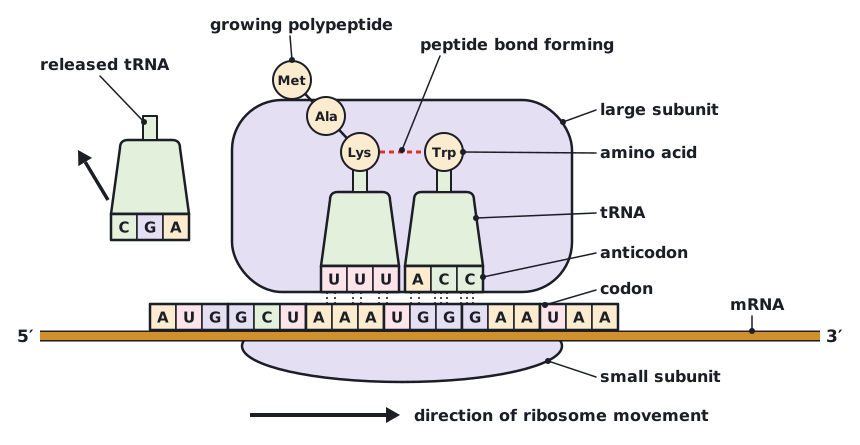 (opens full size in a new tab)
Written and checked against the Edexcel International AS Level Biology (XBI11) specification · Updated October 2026