
Niche and adaptations to the environmentSpec 4.19
In short
A niche is the role of a species in its habitat, including how it obtains food, the abiotic conditions it tolerates and its interactions with other species. Adaptations that fit organisms to their niche may be behavioural, anatomical or physiological. Two species cannot occupy exactly the same niche in the same place indefinitely, because they would compete.
- Niche
- The role of a species within its habitat: how it obtains food and other resources, the abiotic conditions it tolerates and the biotic interactions it has with other species (such as feeding relationships, competition and predation).
Each species in a habitat has its own niche. If two species have very similar niches they compete for the same resources, and one is likely to decline, so competition tends to separate the niches of species living together. Organisms are adapted to their niche: a feature that helps survival and reproduction in a particular environment is an adaptation. Adaptations are the result of natural selection.
| Type | Meaning | Examples |
|---|---|---|
| Behavioural | The way an organism acts | Hibernation in winter; migration; nocturnal activity in desert animals to avoid the heat of the day; courtship displays; basking to warm up |
| Anatomical | Structural features of the body that can be seen in a dissection or section | Marram grass has rolled leaves, hairs and sunken stomata that reduce transpiration; thick fur and a layer of fat in polar bears; large ears in desert foxes that lose heat |
| Physiological | Processes inside the body, including biochemical ones | Kangaroo rats produce very concentrated urine, conserving water; antifreeze proteins in polar fish; production of venom or toxins; slowed metabolism during hibernation |
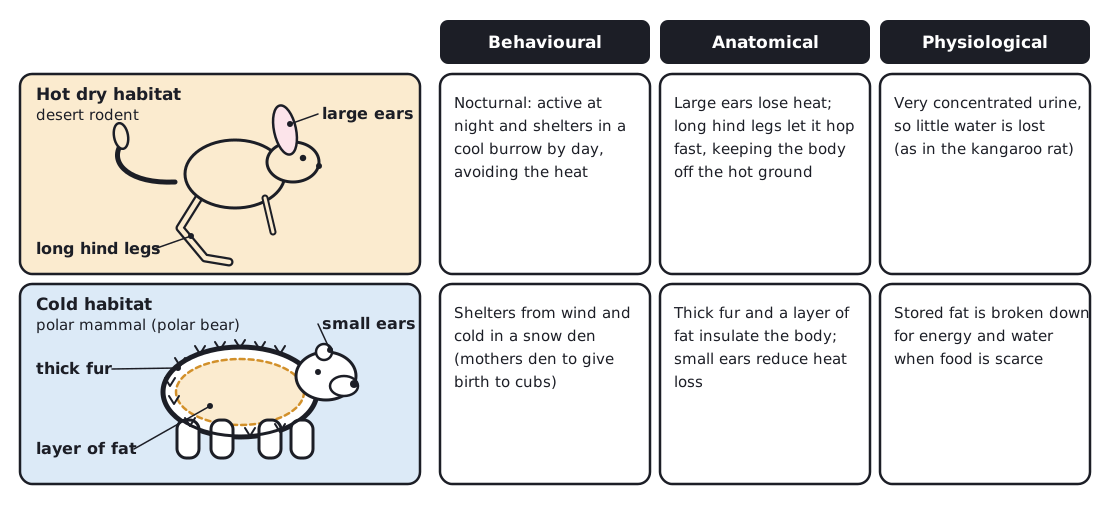 (opens full size in a new tab)
When asked to discuss adaptations, name the type (behavioural, anatomical or physiological), give the feature and link it to survival in that environment, for example by reducing water loss.
Written and checked against the Edexcel International AS Level Biology (XBI11) specification · Updated October 2026