
The structure of mononucleotides, DNA and RNASpec 2.9
In short
A mononucleotide is a pentose sugar (deoxyribose or ribose) joined to a phosphate group and a base. Condensation reactions link mononucleotides by phosphodiester bonds into polynucleotides. DNA is two antiparallel polynucleotide strands held in a double helix by hydrogen bonds between complementary bases: A with T, and C with G.
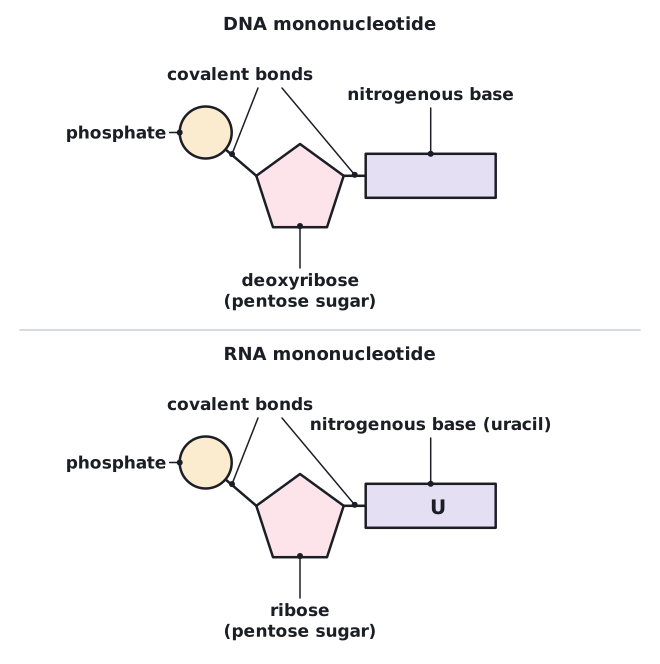
A mononucleotide has three parts: a pentose sugar, a phosphate group and a nitrogen-containing base. In DNA the sugar is deoxyribose; in RNA it is ribose. DNA has four bases: adenine (A), thymine (T), cytosine (C) and guanine (G). In RNA, thymine is replaced by uracil (U).
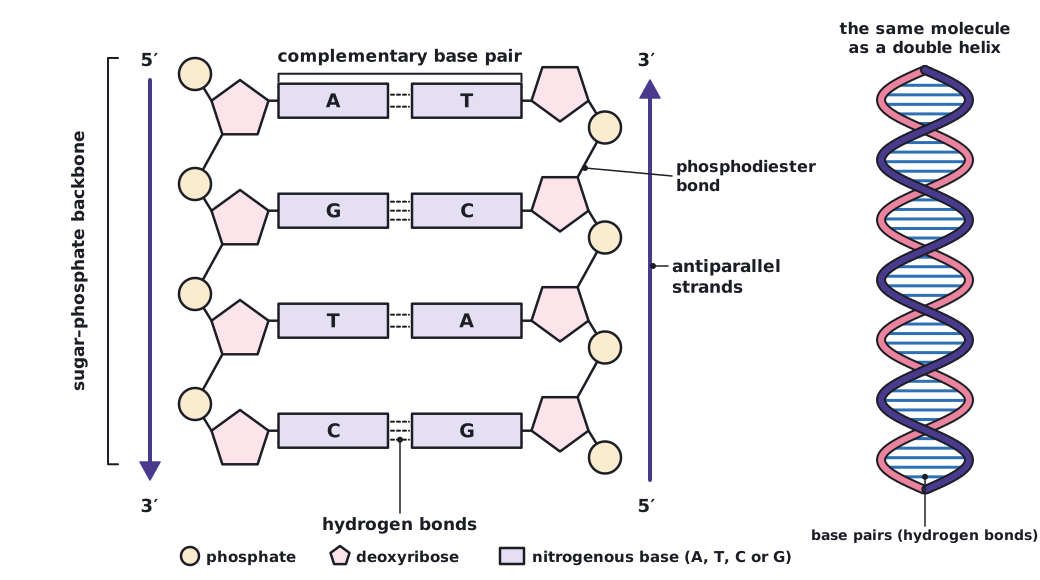
Mononucleotides join in condensation reactions. A phosphodiester bond forms between the phosphate group of one nucleotide and the sugar of the next, releasing water. Many nucleotides in a chain make a polynucleotide, with a sugar–phosphate backbone and bases sticking out to the side.
The DNA double helix
- A DNA molecule is made of two polynucleotide strands wound into a double helix.
- The strands are antiparallel: they run in opposite directions (one runs 5′ to 3′, the other 3′ to 5′).
- Complementary base pairing: adenine pairs with thymine (two hydrogen bonds) and cytosine pairs with guanine (three hydrogen bonds). The base pairs lie across the middle of the helix.
- Many hydrogen bonds hold the two strands together. Each bond is weak, so the strands can be separated for replication and transcription, but together they make DNA stable.
- The sugar–phosphate backbones protect the bases on the inside.
| Feature | DNA | RNA |
|---|---|---|
| Sugar | Deoxyribose | Ribose |
| Bases | A, T, C, G | A, U, C, G |
| Strands | Two polynucleotide strands, double helix | One polynucleotide strand |
| Size | Very long | Relatively short |
| Types | — | Messenger RNA (mRNA), transfer RNA (tRNA), ribosomal RNA (rRNA) |
Phosphodiester bonds join nucleotides along one strand; hydrogen bonds join bases between two strands. Do not mix them up, and do not say hydrogen bonds link A with G.
 (opens full size in a new tab)
 (opens full size in a new tab)
Written and checked against the Edexcel International AS Level Biology (XBI11) specification · Updated October 2026