
Globular and fibrous proteins: haemoglobin and collagenSpec 2.6
In short
Globular proteins such as haemoglobin are compact, rounded and soluble, with hydrophilic R groups outside, so they carry out metabolic roles. Fibrous proteins such as collagen are long and rope-like, insoluble and strong, with many cross-links, so they provide structural support. Each structure suits its function.
| Feature | Globular (for example haemoglobin) | Fibrous (for example collagen) |
|---|---|---|
| Shape | Compact, rounded, folded. | Long, rope-like fibres. |
| Solubility | Soluble in water: hydrophilic R groups face outwards, hydrophobic R groups face inwards. | Insoluble: many hydrophobic R groups on the outside. |
| Structure | Complex tertiary (and often quaternary) structure. | Repetitive amino acid sequence; little tertiary folding; chains wound together. |
| Role | Metabolic: transport, enzymes, hormones, antibodies. | Structural: strength and support. |
Haemoglobin
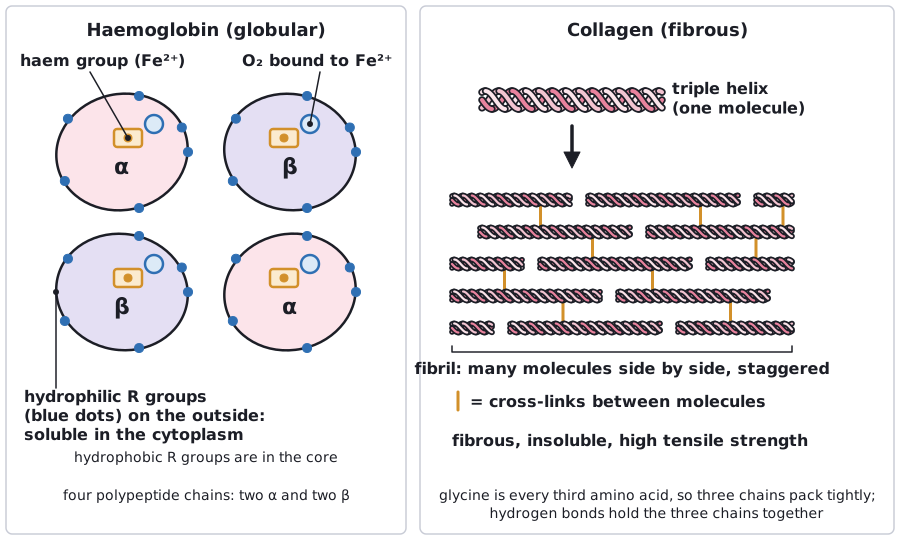
Haemoglobin is a globular protein with quaternary structure: four polypeptide chains (two alpha and two beta chains). Each chain is folded around a haem group that contains an iron ion (Fe²⁺), which binds one oxygen molecule, so each haemoglobin molecule can carry four oxygen molecules. The hydrophilic R groups on the outside make haemoglobin soluble in the cytoplasm of red blood cells, and the precise shape allows it to bind and release oxygen.
Collagen
Collagen is a fibrous protein found in tendons, skin, bones, the walls of arteries and cartilage. Three polypeptide chains, each a left-handed helix, are wound together into a right-handed triple helix. Every third amino acid is glycine, the smallest amino acid, which allows the three chains to pack tightly together. The chains are held together by many hydrogen bonds, and neighbouring collagen molecules are linked by covalent cross-links, making fibrils and fibres. This gives collagen a very high tensile strength and makes it insoluble, which suits its structural function.
Always link structure to function: 'haemoglobin is soluble because hydrophilic R groups are on the outside, so it can be carried in the cytoplasm of red blood cells'; 'collagen has high tensile strength because of hydrogen bonds between three chains and cross-links between molecules'.
 (opens full size in a new tab)
Written and checked against the Edexcel International AS Level Biology (XBI11) specification · Updated October 2026