
Plant cell ultrastructure and its functionsSpec 4.1, 4.2
In short
Plant cells are eukaryotic cells with a cellulose cell wall, chloroplasts, amyloplasts and a large permanent vacuole surrounded by a tonoplast. Neighbouring cells are cemented together by the middle lamella and linked through pits and plasmodesmata. These features separate plant cells from animal cells and can be recognised in electron micrographs.
A plant cell has all the organelles of a eukaryotic cell (nucleus, mitochondria, rough endoplasmic reticulum, Golgi apparatus, ribosomes), plus several structures that animal cells lack. Learn the structure and the function of each one in the table, because both are examined.
| Structure | Ultrastructure | Function |
|---|---|---|
| Cell wall | Outside the cell surface membrane. Cellulose microfibrils embedded in a matrix of other polysaccharides (such as hemicelluloses and pectins). Fully permeable. | Gives the cell strength and shape. Resists the pressure of water entering by osmosis, so the cell does not burst and becomes turgid. |
| Middle lamella | A thin layer between the walls of neighbouring cells, rich in pectins (calcium pectate). | Cements (sticks) adjacent cells together. |
| Chloroplast | Typically 3–10 µm long. Surrounded by a double membrane (envelope). Inside: stacks of thylakoid membranes (grana) joined by lamellae, containing chlorophyll; a fluid stroma containing enzymes, 70S ribosomes, circular DNA, lipid droplets and starch grains. | Site of photosynthesis. Light-dependent reactions occur on the thylakoid membranes; light-independent reactions occur in the stroma. |
| Amyloplast | A colourless organelle with a double membrane, packed with starch grains. No chlorophyll or thylakoids. | Stores starch, for example in potato tubers, roots and seeds. |
| Vacuole | A large, permanent, fluid-filled sac. The fluid is cell sap: a solution of water, sugars, amino acids, mineral ions, pigments and waste. | Stores solutes and water. Its water content helps keep the cell turgid, which supports non-woody plants. |
| Tonoplast | The single, partially permeable membrane surrounding the vacuole. Contains transport proteins. | Controls what enters and leaves the vacuole, for example by active transport of ions into the sap. |
| Plasmodesmata | Narrow channels through the cell walls, lined by the cell surface membrane and containing a thin strand of cytoplasm that links the cytoplasm of neighbouring cells. | Allow substances and chemical signals to pass directly from cell to cell. |
| Pits | Regions where the wall is thin because secondary thickening was not laid down there. Pits in neighbouring cells line up as pairs. | Allow water and dissolved substances to move between adjacent cells, for example from one xylem vessel to the next. |
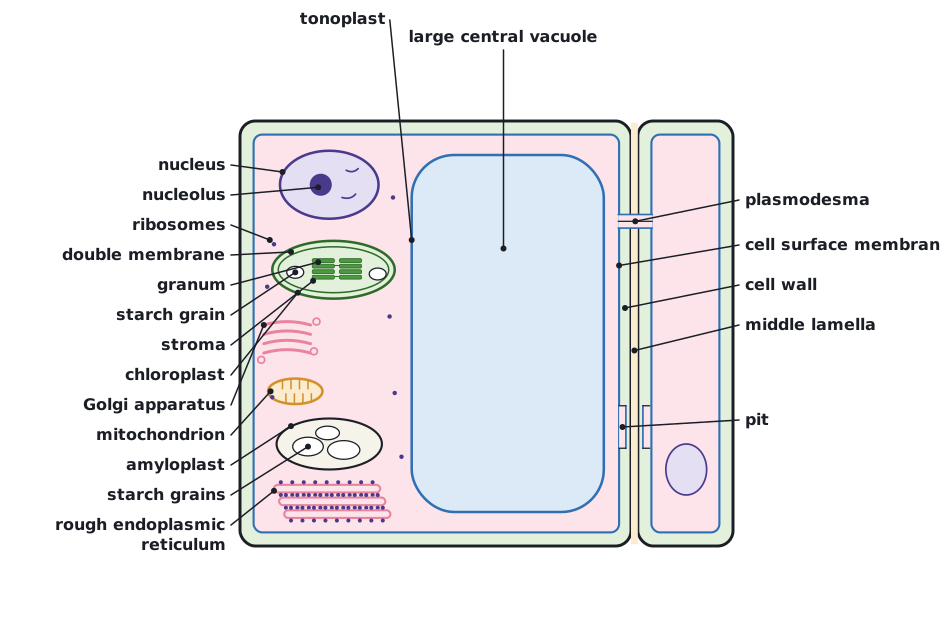 (opens full size in a new tab)
Comparing plant and animal cells
| Feature | Plant cell | Animal cell |
|---|---|---|
| Cell wall | Present, made of cellulose | Absent |
| Chloroplasts | Present in photosynthetic cells | Absent |
| Vacuole | One large permanent vacuole with a tonoplast | None, or small temporary vacuoles |
| Carbohydrate store | Starch (in amyloplasts and chloroplasts) | Glycogen (in the cytoplasm) |
| Shape | Fixed, often regular, because of the wall | Variable; no fixed shape |
| Centrioles | Absent in flowering plants | Present |
| Both have | Nucleus, cell surface membrane, mitochondria, ribosomes, rough endoplasmic reticulum, Golgi apparatus | Same |
For compare questions give a similarity and a difference, and write about both cell types in the same sentence. "Plant cells have a cell wall" scores less than "plant cells have a cellulose cell wall but animal cells do not".
Recognising organelles in electron micrographs
- Chloroplast: oval, double membrane, internal stacks of discs (grana), often with pale starch grains.
- Amyloplast: rounded, double membrane, filled with large pale or dense starch grains, no internal stacks.
- Vacuole: very large, pale and featureless, bounded by a single thin line (tonoplast) and pushing the cytoplasm and nucleus to the edge.
- Cell wall and middle lamella: a thick layer outside the cell membrane; the middle lamella is the thin line between the walls of two neighbouring cells.
- Plasmodesmata: narrow gaps crossing the wall, joining the cytoplasm of two cells.
The tonoplast is the membrane around the vacuole. It is not the cell wall and it is not the cell surface membrane.
Written and checked against the Edexcel International AS Level Biology (XBI11) specification · Updated October 2026