
Gene mutationsSpec 2.14
In short
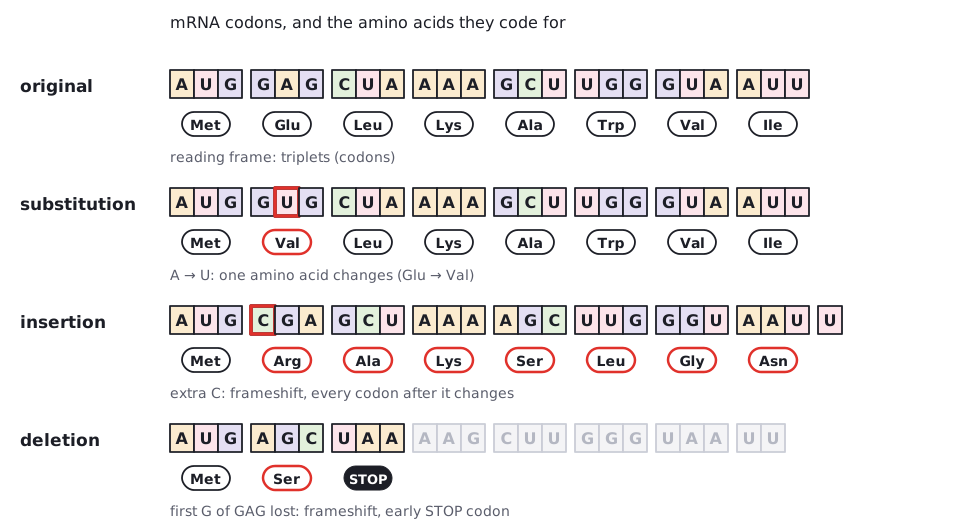
A gene mutation is a change in the base sequence of DNA, arising from errors in DNA replication. The mutations are substitution, insertion or deletion of bases. Some lead to cancer or genetic disorders, but many have no observable effect, for example because the genetic code is degenerate.
A mutation is a change in the sequence of bases in DNA. Mutations can arise from errors in DNA replication, when the wrong nucleotide is inserted, or when a base is added or missed out.
| Type | What happens | Possible effect |
|---|---|---|
| Substitution | One base is replaced by another. | Only one codon changes. The amino acid may stay the same (code is degenerate), change to a different amino acid, or become a stop codon (shorter polypeptide). |
| Insertion | An extra base is added. | Reading frame shifts (frameshift): every codon after the insertion changes, so a completely different sequence of amino acids is likely. |
| Deletion | A base is lost. | Frameshift: every codon after the deletion changes. (Adding or deleting three bases would add or remove one amino acid without shifting the rest.) |
Effect of a deletion
The mRNA sequence AUG GAA CCU UUA is read in codons. The first G after AUG is deleted, giving AUG AAC CUU UA. State the effect on the codons.
- Original codons: AUG GAA CCU UUA (four codons).
- After the deletion the bases are AUGAACCUUUA, read in threes: AUG AAC CUU UA.
- Every codon after the deletion has changed (GAA → AAC, CCU → CUU), so the amino acid sequence after the mutation is changed.
Answer: A frameshift: all the codons after the deletion are changed, giving a different amino acid sequence.
Consequences of mutations
- Some mutations cause cancer, if they occur in genes that control cell division, leading to uncontrolled cell division and a tumour.
- Some cause genetic disorders, if the protein made is faulty, for example the mutation that causes cystic fibrosis.
- Many mutations have no observable effect: the code is degenerate so the amino acid may not change; the change may be in a part of DNA that does not code for a protein; or the new amino acid may not alter the shape of the protein.
In a question about the effect of a mutation, work through the chain: base sequence → mRNA codon → amino acid sequence → tertiary structure → function. Say whether it is a substitution or a frameshift.
 (opens full size in a new tab)
Quick check
Name the bond that joins nucleotides in one DNA strand.
Show answer
A phosphodiester bond, formed by a condensation reaction.
Which bases pair together in DNA?
Show answer
Adenine with thymine (two hydrogen bonds), cytosine with guanine (three hydrogen bonds).
What does semi-conservative mean?
Show answer
Each new DNA molecule has one original strand and one newly made strand.
What is the role of RNA polymerase in transcription?
Show answer
It breaks the hydrogen bonds, and joins RNA nucleotides complementary to the template strand by phosphodiester bonds.
What is an anticodon?
Show answer
Three bases on a tRNA molecule that are complementary to a codon on mRNA.
Written and checked against the Edexcel International AS Level Biology (XBI11) specification · Updated October 2026