
Saturated and unsaturated lipidsSpec 1.5(ii)
In short
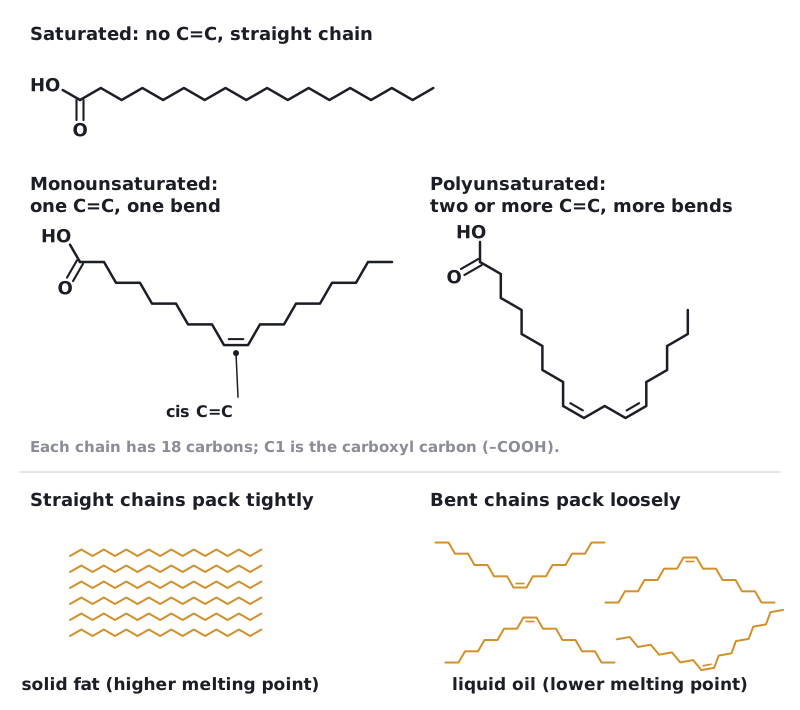
Saturated lipids contain fatty acids with no carbon-to-carbon double bonds, so their straight chains pack closely and they are usually solid at room temperature. Unsaturated lipids contain one or more C=C double bonds, which bend the chain, so they pack less closely and are usually liquid oils. Diets high in saturated fat are linked with raised LDL cholesterol.
| Feature | Saturated | Unsaturated |
|---|---|---|
| C=C double bonds in the hydrocarbon chain | None: every carbon holds the maximum number of hydrogen atoms | One (monounsaturated) or more than one (polyunsaturated) |
| Shape of the chain | Straight | Bent (kinked) at each double bond |
| Packing of molecules | Pack closely together | Pack less closely |
| Melting point | Higher, so usually solid at room temperature | Lower, so usually liquid at room temperature |
| Typical sources | Butter, lard, animal fats | Olive oil, sunflower oil, oily fish |
 (opens full size in a new tab)
Because straight chains pack closely, there are more intermolecular attractions between them, so more energy is needed to separate the molecules. This explains why saturated fats have a higher melting point than unsaturated oils.
Health link: diets high in saturated fat tend to raise the concentration of low-density lipoprotein (LDL) cholesterol in the blood, which raises the risk of cardiovascular disease (see the section on dietary risk factors).
Unsaturated means at least one C=C double bond in the hydrocarbon chain. Do not write 'unsaturated fats have no hydrogen' or confuse the term with the number of ester bonds.
Quick check
What is a dipole?
Show answer
A molecule with a slightly positive end and a slightly negative end because its electrons are shared unevenly.
Name the two types of bond in amylopectin.
Show answer
α-1,4 glycosidic bonds (main chain) and α-1,6 glycosidic bonds (branch points).
Which two monosaccharides join to make sucrose?
Show answer
Glucose and fructose.
How many water molecules are released when a triglyceride forms?
Show answer
Three, one for each ester bond formed.
What colour change shows starch with iodine solution?
Show answer
Yellow-brown to blue-black.
Written and checked against the Edexcel International AS Level Biology (XBI11) specification · Updated October 2026