
Enzymes: mode of action and specificitySpec 2.7
In short
Enzymes are biological catalysts that reduce the activation energy of reactions. A substrate binds to the active site, a region whose three-dimensional shape is complementary to it, forming an enzyme–substrate complex. Intracellular enzymes work inside cells and extracellular enzymes are secreted to work outside cells.
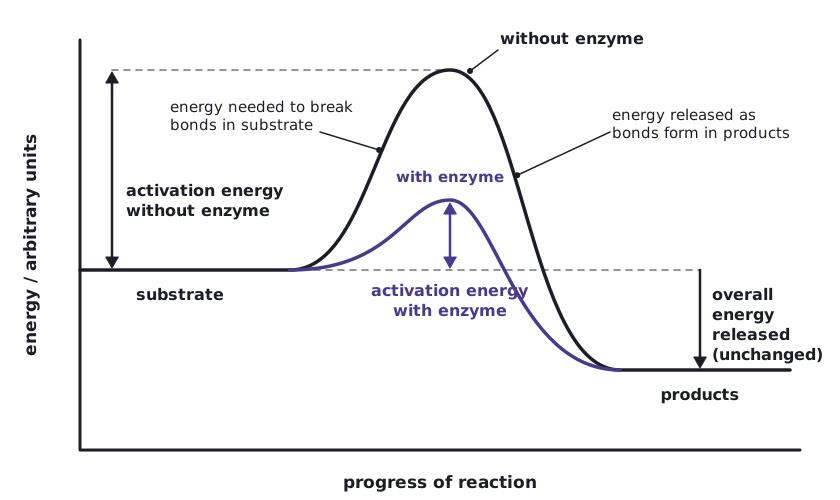
An enzyme is a globular protein that acts as a biological catalyst: it speeds up a chemical reaction without being used up. It does this by lowering the activation energy, the energy needed to start the reaction. The enzyme is not changed overall and can be used again.
The active site and specificity
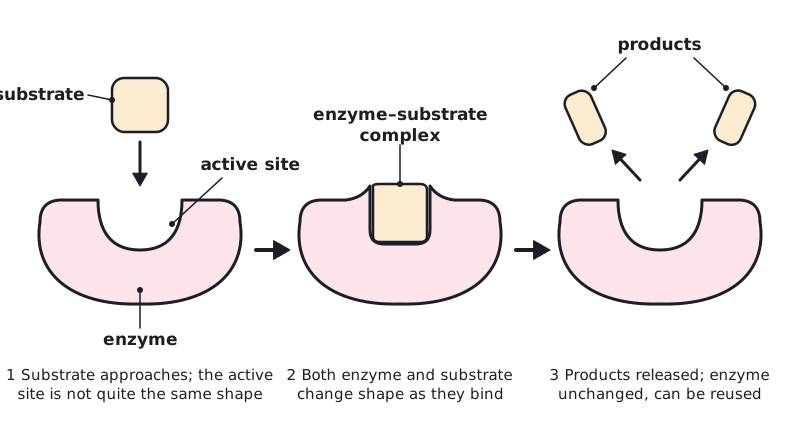
An enzyme has an active site, a small region of the molecule that has a particular three-dimensional shape and charge pattern, set by the enzyme's tertiary structure. The substrate has a complementary shape and binds to the active site, forming an enzyme–substrate complex. The products leave and the enzyme can bind another substrate.
- The substrate collides with the active site and binds, forming an enzyme–substrate complex.
- The active site changes shape slightly to fit the substrate more closely (induced fit), which puts strain on bonds in the substrate.
- This lowers the activation energy, so the substrate is converted to products.
- The products leave the active site, which returns to its original shape.
Enzymes are specific: the shape of the active site only fits a particular substrate (or a small group of similar substrates). A different substrate cannot bind, so only one reaction is catalysed. The tertiary structure is determined by the primary structure, so a change in amino acid sequence can alter the active site and affect the enzyme's activity.
Intracellular and extracellular enzymes
- Intracellular enzymes catalyse reactions inside cells, for example catalase, which breaks down hydrogen peroxide inside cells, and the enzymes of respiration in the mitochondria.
- Extracellular enzymes are made in cells and secreted to catalyse reactions outside the cells, for example amylase and trypsin, which are secreted into the digestive system to digest starch and protein.
'Lowers the activation energy' is the key mark point for how an enzyme works. Say that the substrate fits the active site because of its complementary shape, and that the shape is due to the tertiary structure.
 (opens full size in a new tab)
 (opens full size in a new tab)
Written and checked against the Edexcel International AS Level Biology (XBI11) specification · Updated October 2026