
Core Practical 6: root tip squashSpec 3.15
In short
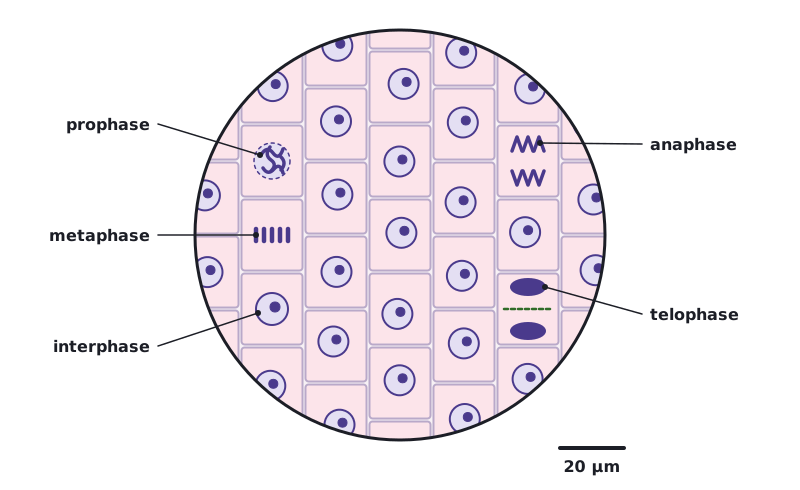
In Core Practical 6, a root tip is warmed in hydrochloric acid, stained with a chromosome stain such as acetic orcein and squashed into a thin layer on a slide. Under a light microscope, cells from the growing region can be seen in different stages of mitosis. The root tip is used because it contains meristem cells that are dividing.
Core practical 6: prepare and stain a root tip squash to observe the stages of mitosis.
Root tips (for example onion, garlic or broad bean) are used because the meristem just behind the tip is the region where cells are dividing rapidly by mitosis.
- Cut about 2 to 3 mm from the end of a growing root tip with a scalpel and place it in warm (about 60 °C) 1 M hydrochloric acid for about 5 minutes. The acid softens the tissue by breaking down the middle lamella between cells, so that the cells can be separated, and it kills the cells, fixing them in their stage.
- Rinse the root tip in water and place it on a clean microscope slide.
- Add a few drops of a stain that binds to chromosomes, such as acetic orcein, and leave for a few minutes. Spread out the tissue with a mounted needle.
- Lower a coverslip on at an angle. Cover it with a piece of filter paper and press down firmly with a thumb, without sliding the coverslip sideways, to squash the tissue into a thin layer of cells.
- View under a light microscope, starting at low power to find the region with small, square, densely stained cells, then at high power to identify the stage of each cell.
- Make labelled drawings of cells in each stage and count the cells in each stage in several fields of view.
- Variables to control when comparing roots: same type of plant, same length of root tip, same time in acid and stain, same temperature.
- Risks: 1 M hydrochloric acid is an irritant, so wear eye protection; hot water baths can scald; acetic orcein stains skin and clothing and is an irritant; scalpels are sharp, so cut away from the body on a hard surface.
- Reliability: count a large number of cells (at least several hundred) and repeat on several root tips to reduce the effects of chance.
Explain each step, not just the order. The squash gives a layer one cell thick, so light can pass through, and the acid separates the cells and stops further division.
 (opens full size in a new tab)
Written and checked against the Edexcel International AS Level Biology (XBI11) specification · Updated October 2026