
Active transport, endocytosis and exocytosisSpec 2.5
In short
Active transport moves substances across a membrane against their concentration gradient, using energy from ATP and carrier proteins. Endocytosis and exocytosis move large particles and bulk materials into and out of cells in vesicles formed from, or fusing with, the cell-surface membrane. Both also need ATP.
Active transport
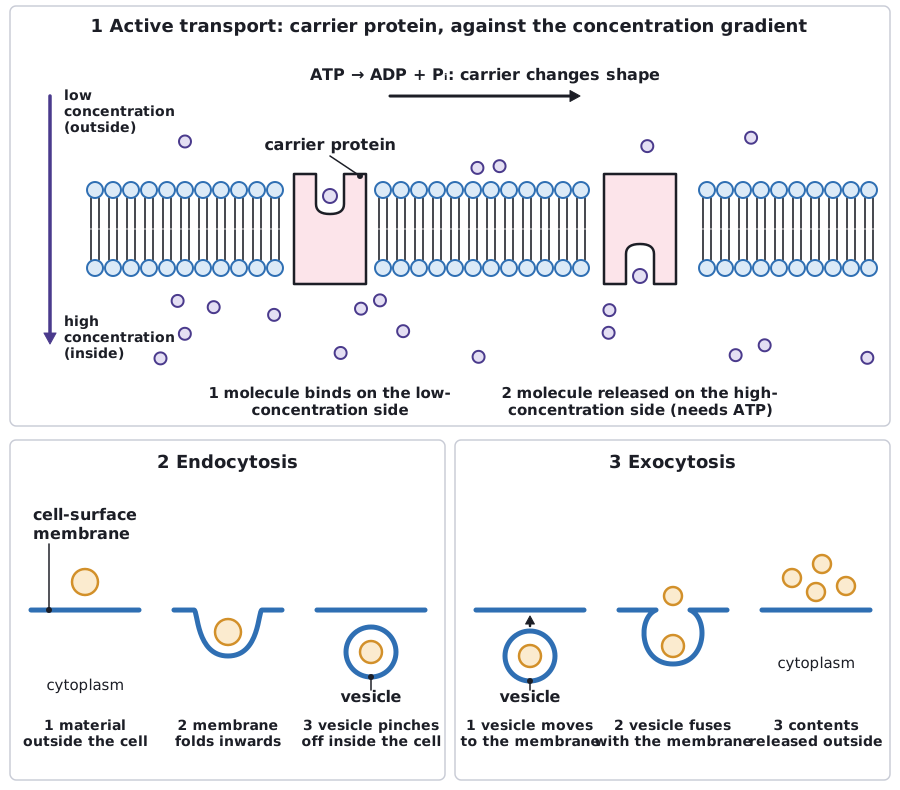
Active transport is the movement of molecules or ions across a membrane against a concentration gradient, using energy from ATP and a carrier protein. ATP is the immediate source of energy for the cell. It is hydrolysed to ADP and inorganic phosphate (Pᵢ), which releases energy.
- The molecule or ion to be moved binds to a specific site on a carrier protein.
- ATP binds to the carrier protein and is hydrolysed to ADP + Pᵢ, which releases energy.
- The protein changes shape and releases the molecule on the other side of the membrane, against the gradient.
- The protein returns to its original shape, ready to bind again.
Endocytosis and exocytosis
- Endocytosis is the bulk transport of material into a cell. A region of the cell-surface membrane folds inwards around the material and pinches off to form a vesicle inside the cell. Cells use it to take in large particles or fluid droplets; ATP is needed.
- Exocytosis is the bulk transport of material out of a cell. A vesicle (often from the Golgi apparatus) moves to the cell-surface membrane, fuses with it and releases its contents outside. Cells use it to secrete substances such as enzymes and hormones; ATP is needed.
| Feature | Diffusion | Facilitated diffusion | Active transport |
|---|---|---|---|
| Direction relative to gradient | Down | Down | Against |
| ATP needed | No | No | Yes |
| Protein needed | No | Yes (channel or carrier) | Yes (carrier) |
| Specific | No | Yes | Yes |
A good mark point for active transport is 'ATP is hydrolysed to ADP and Pᵢ, which releases energy'. An answer that only says 'uses energy' is not enough. Cells with a lot of active transport have many mitochondria.
Endocytosis and exocytosis are not diffusion or osmosis, and they do not use channel or carrier proteins. They move bulk material in vesicles and they need ATP.
 (opens full size in a new tab)
Quick check
State the three properties of a gas exchange surface.
Show answer
A large surface area to volume ratio, a thin surface (short diffusion distance) and a large concentration difference.
What happens to the rate of diffusion if the thickness of the exchange surface doubles?
Show answer
It halves, because the rate is inversely proportional to the thickness (Fick's law).
Why can oxygen cross the phospholipid bilayer, but sodium ions cannot?
Show answer
Oxygen is small and non-polar, so it dissolves in the hydrophobic centre. Ions are charged and are repelled by it.
Define osmosis.
Show answer
The net movement of free water molecules through a partially permeable membrane, down a water potential gradient.
What is the role of ATP in active transport?
Show answer
It is hydrolysed to ADP and Pᵢ, releasing the energy that changes the shape of the carrier protein.
Written and checked against the Edexcel International AS Level Biology (XBI11) specification · Updated October 2026