
Ultrastructure of eukaryotic cellsSpec 3.3
In short
Eukaryotic cells contain organelles, each with a structure suited to its function. The nucleus holds DNA, the nucleolus makes ribosomal RNA, ribosomes make proteins, rough ER transports proteins, smooth ER makes lipids, mitochondria release ATP, centrioles form the spindle, lysosomes digest, and the Golgi apparatus modifies and packages proteins.
Ultrastructure is the fine detail of a cell that can only be seen with an electron microscope. The organelles you need to know are summarised below.
| Organelle | Structure | Function |
|---|---|---|
| Nucleus | Surrounded by a double membrane (nuclear envelope) with nuclear pores; contains chromatin (DNA wound round histone proteins) | Stores genetic information; DNA is transcribed here; pores let mRNA out and proteins in; site of DNA replication |
| Nucleolus | Dense, darkly staining region inside the nucleus, with no membrane | Makes ribosomal RNA (rRNA) and assembles it with proteins into ribosome subunits |
| Ribosomes | Tiny, made of rRNA and protein, no membrane; free in the cytoplasm or attached to rough ER | Site of protein synthesis (translation) |
| Rough endoplasmic reticulum (rER) | System of flattened, membrane-bound sacs (cisternae) continuous with the nuclear envelope, with ribosomes on the outer surface | Proteins made on its ribosomes enter the lumen, where they are folded and transported |
| Smooth endoplasmic reticulum (sER) | Network of membrane-bound tubules with no ribosomes | Synthesises and transports lipids and steroids (for example steroid hormones) |
| Mitochondrion | Double membrane; inner membrane folded into cristae; fluid matrix inside | Site of aerobic respiration, producing ATP; cristae give a large surface area for the enzymes of the electron transport chain |
| Centrioles | A pair of short hollow cylinders at right angles to each other, each made of microtubules; found in animal cells | Form the spindle (organise the microtubules) during nuclear division |
| Lysosome | Small, round, single-membrane-bound sac, made by the Golgi apparatus, containing hydrolytic (digestive) enzymes | Digests worn-out organelles and material brought into the cell, such as bacteria engulfed by phagocytosis; can break down the cell itself after death |
| Golgi apparatus | A stack of flattened, membrane-bound sacs with vesicles budding from the edges | Modifies proteins (for example adds carbohydrate to make glycoproteins), packages them into vesicles, and makes lysosomes |
Mitochondria do not 'make energy'. Say they produce ATP by aerobic respiration, which is the immediate source of energy for the cell.
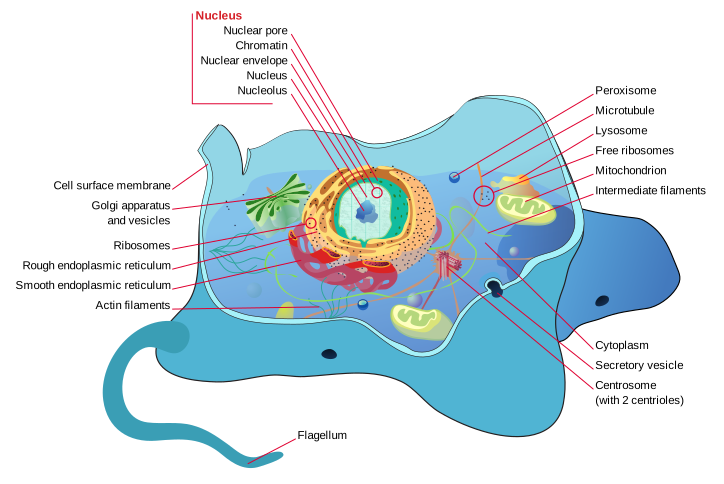 (opens full size in a new tab)
Written and checked against the Edexcel International AS Level Biology (XBI11) specification · Updated October 2026