
The oxygen dissociation curve, the Bohr effect and fetal haemoglobinSpec 1.9(ii)
In short
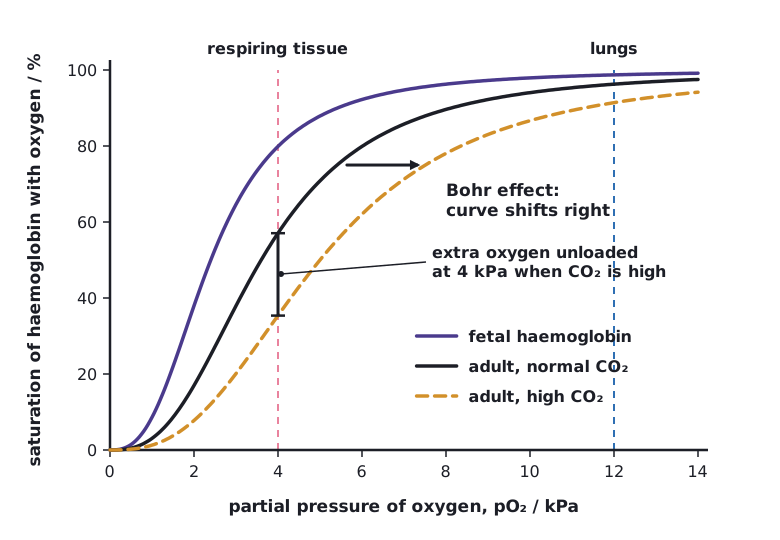
The oxygen dissociation curve plots percentage saturation of haemoglobin against the partial pressure of oxygen and is S-shaped. The Bohr effect is the shift of the curve to the right at high carbon dioxide levels, so more oxygen unloads in respiring tissues. Fetal haemoglobin has a higher affinity, so its curve is to the left.
The oxygen dissociation curve shows the percentage saturation of haemoglobin with oxygen (y-axis) against the partial pressure of oxygen, pO₂, in kPa (x-axis). The curve is S-shaped (sigmoid).
 (opens full size in a new tab)
Why the curve is S-shaped
- At low pO₂ the curve is shallow. The first oxygen molecule is hard to bind because the haem groups are inside the protein.
- Once one oxygen molecule binds, the haemoglobin changes shape slightly, making it easier for the next ones to bind. This cooperative binding gives the steep middle section.
- At high pO₂ the curve levels off because haemoglobin is almost saturated: few haem groups are still free, so a further rise in pO₂ adds little more oxygen.
In the lungs (high pO₂) haemoglobin is about 95 % or more saturated. In respiring tissues (low pO₂) it is much less saturated, because it releases oxygen. The steep part of the curve is at the pO₂ of respiring tissues, so a small fall in pO₂ makes a large amount of oxygen unload.
The Bohr effect
Respiring tissues release CO₂. CO₂ forms carbonic acid, which dissociates to release H⁺ ions, so a higher partial pressure of CO₂ lowers the pH. Haemoglobin changes shape, its affinity for oxygen falls, and the curve shifts to the right. This is the Bohr effect. At a given pO₂ the haemoglobin is then less saturated, so more oxygen is unloaded where it is needed most, in active tissues. In the lungs, where CO₂ is removed, the affinity rises again and oxygen loads easily.
Fetal haemoglobin
Fetal haemoglobin has a higher affinity for oxygen than adult haemoglobin at all partial pressures. Its curve lies to the left of the adult curve. In the placenta the pO₂ is low, so the mother’s haemoglobin unloads oxygen, and the fetal haemoglobin, which is still highly saturated at this low pO₂, loads it. Oxygen is therefore transferred from mother to fetus.
| pO₂ / kPa | Adult Hb (%) | Fetal Hb (%) |
|---|---|---|
| 2 | 17 | 33 |
| 4 | 57 | 76 |
| 6 | 80 | 90 |
| 8 | 90 | 95 |
| 10 | 94 | 97 |
| 12 | 96 | 98 |
'Shift to the right' means lower affinity, so more oxygen is released at the same pO₂. Describe a shift in terms of percentage saturation at a stated pO₂, and use values from the graph if one is given.
Quick check
Why does a large animal need a circulatory system?
Show answer
Its surface area to volume ratio is small and diffusion distances are long, so diffusion alone is too slow to supply all cells.
Why is the left ventricle wall thicker than the right?
Show answer
It pumps blood to the whole body at high pressure, whereas the right ventricle only pumps to the lungs.
What are the three stages of the cardiac cycle?
Show answer
Atrial systole, ventricular systole and cardiac diastole.
How many oxygen molecules can one haemoglobin molecule carry?
Show answer
Four, one on each haem group.
What happens to the oxygen dissociation curve when CO₂ concentration increases?
Show answer
It shifts to the right (Bohr effect), so haemoglobin releases more oxygen.
Written and checked against the Edexcel International AS Level Biology (XBI11) specification · Updated October 2026