
Core practical 3: membrane permeability, alcohol and temperatureSpec 2.3
In short
Beetroot cells contain a red pigment (betalain) in their vacuoles. Damage to the cell membranes lets the pigment leak into the surrounding water. By changing temperature or alcohol concentration and measuring how much pigment is released, you can compare the effects on membrane permeability.
Core practical 3: investigate membrane properties including the effect of alcohol and temperature on membrane permeability.
Beetroot cells contain a red-purple pigment, betalain, inside the vacuole. While the vacuole membrane (tonoplast) and the cell-surface membrane are intact, the pigment cannot leave the cell. If the membranes are damaged and become more permeable, pigment leaks out. The more colour in the surrounding liquid, the greater the permeability.
Method (temperature version)
- Use a cork borer to cut cylinders of beetroot of the same diameter. Cut them to the same length with a scalpel on a white tile. Rinse them in distilled water until the water runs clear, to remove pigment released from cut cells.
- Set up water baths at a range of temperatures (for example 0, 10, 20, 30, 40, 50, 60, 70 °C). Check each temperature with a thermometer.
- Put the same volume of distilled water (for example 10 cm³) into each of a set of test tubes, and bring them to temperature in the water baths.
- Add one beetroot cylinder to each tube and leave for the same time (for example 10 minutes).
- Remove the cylinders. Shake each tube gently to mix the liquid, and pour it into a cuvette.
- Measure the absorbance of each liquid in a colorimeter with a blue-green filter, after zeroing it on distilled water. (Or compare colours with a set of colour standards.)
- Repeat at least three times at each temperature and calculate a mean.
For the alcohol version, keep the temperature constant (for example 20 °C) and instead use a set of ethanol concentrations (for example 0, 10, 20, 30, 40, 50 %), made by diluting ethanol with distilled water to the same total volume.
| Type | Temperature version | Alcohol version |
|---|---|---|
| Independent | Temperature of the water | Concentration of ethanol |
| Dependent | Absorbance of the liquid (a measure of pigment released) | Absorbance of the liquid |
| Controlled | Size and shape (surface area) of beetroot piece, same beetroot, volume of liquid, time in liquid, colorimeter filter, rinsing | As temperature version, plus a constant temperature |
Risk management
- Ethanol is flammable: keep it away from flames and wear eye protection.
- Hot water can scald: use a thermostatically controlled bath where possible and do not carry hot water across the room.
- Scalpels and cork borers are sharp: cut on a tile, away from the hand holding the beetroot.
- Beetroot juice stains: wear a lab coat.
Processing and explaining results
- Calculate the mean absorbance at each value of the independent variable. Plot a graph with the independent variable on the x axis and mean absorbance on the y axis. Include units.
- Temperature: little leakage at low temperatures (the membrane is intact and its proteins are not damaged). Above about 40 °C the absorbance rises sharply, because proteins in the membrane denature, which opens gaps, and the phospholipids move more, so the bilayer becomes more fluid and leaky.
- Alcohol: ethanol dissolves lipids and disrupts the phospholipid bilayer (and at higher concentrations denatures membrane proteins), so the membrane becomes more permeable and absorbance rises as the concentration rises.
- Compare with a control (beetroot in distilled water at room temperature) to show that the pigment is not just leaking out anyway.
Calculate a mean of repeats, and ignore anomalous results (explain why you did). When comparing treatments, you can work out the percentage change in absorbance relative to the control: (value − control) ÷ control × 100.
Do not say the membrane 'melts' or that the pigment 'breaks down'. Say that the proteins denature and the phospholipid bilayer is disrupted, so permeability increases.
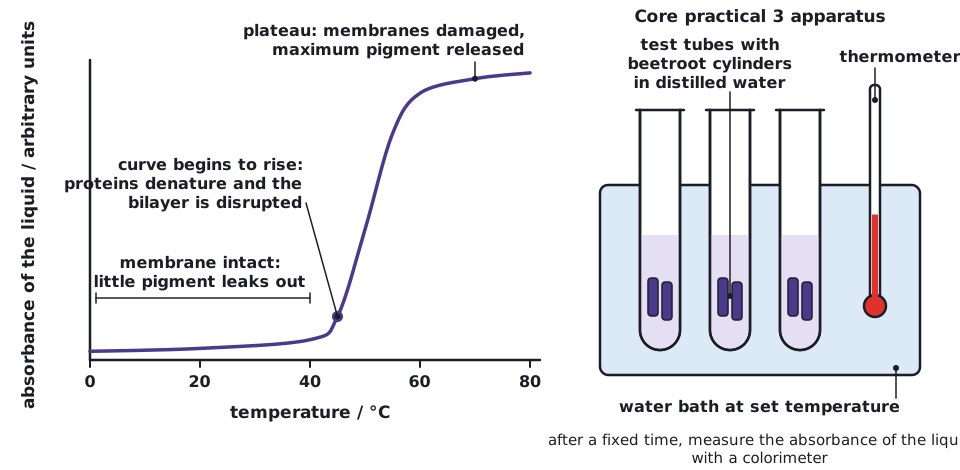 (opens full size in a new tab)
Written and checked against the Edexcel International AS Level Biology (XBI11) specification · Updated October 2026