
Glycosidic bonds: condensation and hydrolysisSpec 1.4
In short
A condensation reaction joins two monosaccharides by forming a glycosidic bond and releasing one molecule of water. Repeating it builds disaccharides (maltose, sucrose, lactose) and polysaccharides (glycogen, amylose, amylopectin). A hydrolysis reaction adds water to break a glycosidic bond and release the monosaccharides again.
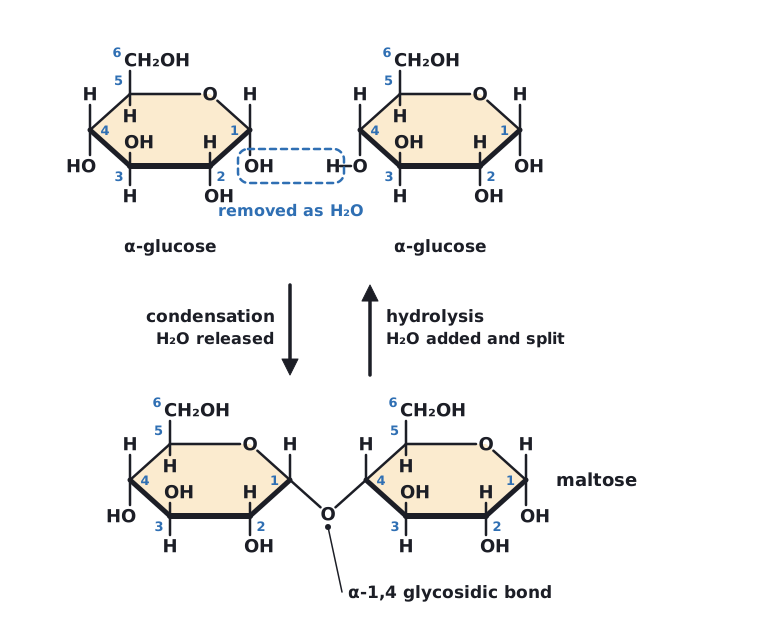
In a condensation reaction, an –OH group on one monosaccharide and an –H on another are removed. They form a molecule of water, and the two sugars are joined by a C–O–C link called a glycosidic bond. In starch and glycogen the main chain is held together by α-1,4 glycosidic bonds (between carbon 1 of one glucose and carbon 4 of the next). Branches are made by α-1,6 glycosidic bonds.
 (opens full size in a new tab)
| Disaccharide | Made from | Found in |
|---|---|---|
| Maltose | Glucose + glucose | Germinating seeds; produced when starch is digested |
| Sucrose | Glucose + fructose | Sugar cane, sugar beet; the main sugar transported in phloem |
| Lactose | Glucose + galactose | Milk |
A polysaccharide is made by repeating condensation many times. A chain of n monosaccharides contains n − 1 glycosidic bonds along the main chain, and n − 1 molecules of water are released when it forms.
Hydrolysis is the reverse reaction. A molecule of water is added across the glycosidic bond, which breaks it and releases the monosaccharides. In living organisms the reaction is catalysed by enzymes, for example amylase on starch and lactase on lactose.
Name the reaction and the bond, and say what happens to water. Condensation forms a glycosidic bond and releases water. Hydrolysis uses water to break the bond.
Written and checked against the Edexcel International AS Level Biology (XBI11) specification · Updated October 2026