
Fertilisation in flowering plantsSpec 3.13
In short
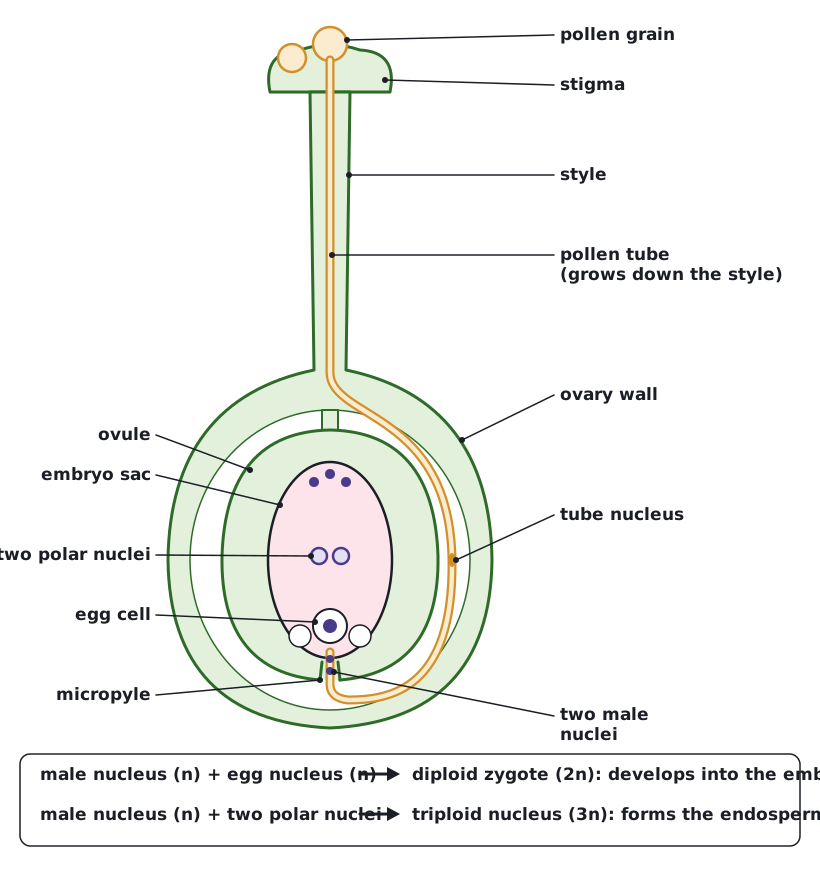
In a flowering plant, a pollen grain lands on a stigma and grows a pollen tube down the style towards an ovule, attracted by chemicals. The tube enters the ovule through the micropyle and its two male nuclei are released. One fuses with the egg nucleus to form the zygote and the other fuses with the polar nuclei to form the endosperm.
After pollination (the transfer of pollen to a stigma), the events of fertilisation take place in the following order.
- A compatible pollen grain absorbs water and nutrients from the stigma and germinates.
- A pollen tube grows out of the grain, down through the style towards the ovary. It is guided by chemicals released by the ovule (chemotropism), and the tube nucleus directs its growth. The tip of the tube secretes enzymes that digest the tissues of the style.
- The generative nucleus divides by mitosis to form two male nuclei, which travel down the tube.
- The tube enters the ovule through a small pore, the micropyle, and enters the embryo sac.
- The tip of the tube bursts and releases the two male nuclei.
- One male nucleus fuses with the nucleus of the egg cell to form a diploid zygote, which develops into the embryo.
- The other male nucleus fuses with the two polar nuclei in the centre of the embryo sac to form a triploid nucleus, which develops into the endosperm (food store). This is called double fertilisation.
 (opens full size in a new tab)
The pollen tube carries nuclei, not sperm cells. Describe the fusion of nuclei: male nucleus with egg nucleus, and male nucleus with the polar nuclei.
Quick check
Define the term locus.
Show answer
The location of a gene on a chromosome.
In which stage of meiosis does crossing over occur?
Show answer
Prophase I.
Why is the zona pellucida hardened after fertilisation?
Show answer
To prevent other sperm from entering, which would cause polyspermy.
What do the two male nuclei do in a flowering plant?
Show answer
One fuses with the egg nucleus to form the zygote; the other fuses with the polar nuclei to form the endosperm.
Why does a sperm have many mitochondria?
Show answer
To make ATP by aerobic respiration for the movement of the flagellum.
Written and checked against the Edexcel International AS Level Biology (XBI11) specification · Updated October 2026