
Alveoli and gas exchangeSpec 2.48
In short
Alveoli are the tiny air sacs at the ends of the bronchioles where gas exchange happens by diffusion between the air in the lungs and the blood in the capillaries. They have a huge total surface area, a diffusion distance of only two thin walls, and a concentration gradient kept steep by blood flow and ventilation.
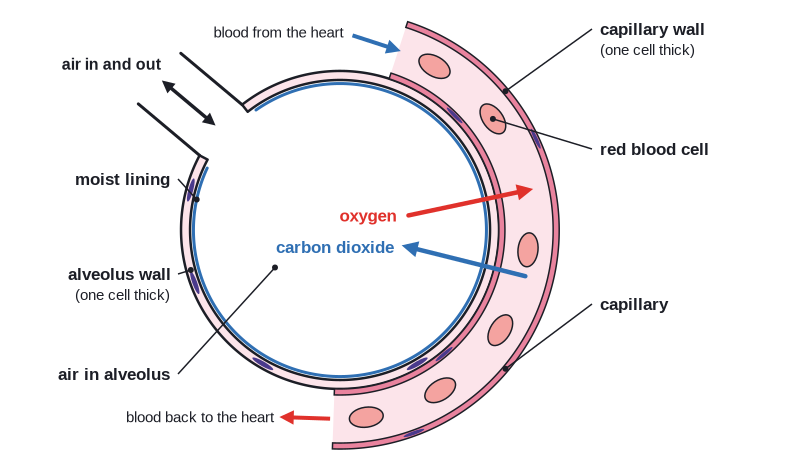
The bronchioles end in clusters of tiny air sacs called alveoli. This is where gas exchange happens: oxygen and carbon dioxide move by diffusion between the air inside the alveoli and the blood flowing through the capillaries that surround them.
- Oxygen: the air in the alveoli has a higher oxygen concentration than the blood arriving in the capillaries, so oxygen diffuses into the blood.
- Carbon dioxide: the blood arriving at the lungs has a higher carbon dioxide concentration than the air in the alveoli, so carbon dioxide diffuses out of the blood and is breathed out.
| Factor it affects | Feature of the alveoli | Why it speeds up gas exchange |
|---|---|---|
| Surface area | Millions of alveoli in each lung | A huge total surface area, so more gas diffuses at the same time |
| Distance | Alveolus wall and capillary wall are each only one cell thick | The gases cross a very short distance |
| Concentration gradient | A dense network of capillaries | Blood constantly carries oxygen away and brings carbon dioxide, so the gradient stays steep |
| Concentration gradient | Ventilation by the intercostal muscles and diaphragm | Fresh air keeps the oxygen concentration in the alveoli high and the carbon dioxide concentration low |
| Dissolving the gases | A thin layer of moisture lines each alveolus | Gases dissolve in it before they diffuse across the walls |
Each adaptation needs two parts: the feature and its effect on diffusion. 'One cell thick' alone is not enough; add 'so the diffusion distance is short'.
 (opens full size in a new tab)
Exam-style question
Emphysema and breathlessness
In emphysema, caused by smoking, the walls of the alveoli break down. Explain why a person with emphysema becomes breathless. [3]
- The surface area for gas exchange is reduced (1 mark).
- Less oxygen diffuses into the blood (1 mark).
- Less oxygen reaches the cells for respiration, so the person breathes faster to try to get more oxygen (1 mark).
Answer: A smaller surface area means less oxygen diffuses into the blood, so the person is short of breath.
Do not mix up ventilation and respiration. Ventilation moves air into and out of the lungs; respiration releases energy inside cells. Also, the gases cross two walls (alveolus and capillary), not one.
Written and checked against the Edexcel IGCSE Biology (4BI1) specification · Updated October 2026