
Practical: energy content of foodSpec 2.33B
In short
The energy in food can be compared by burning a sample under a known mass of water and measuring the temperature rise. Energy released in joules equals mass of water in grams × 4.2 × temperature change, and dividing by the mass of food gives joules per gram. Results are usually too low because heat is lost to the surroundings.
Food stores chemical energy. You can compare the energy in different foods by burning a sample and using the energy released to heat a known mass of water.
- Measure a known volume of water (for example 20 cm³) into a boiling tube and record its starting temperature. 1 cm³ of water has a mass of 1 g.
- Weigh a small piece of food and hold it on a mounted needle.
- Light the food in a Bunsen burner flame, then hold it under the boiling tube straight away until the food stops burning. Stir the water gently.
- Record the highest temperature of the water and work out the temperature change.
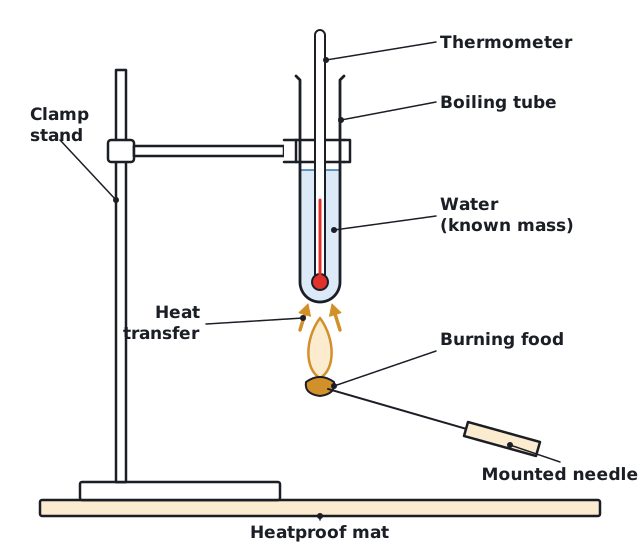 (opens full size in a new tab)
Calculating the energy in food
Burning 0.5 g of a snack raises the temperature of 20 g of water by 12 °C. Calculate the energy released per gram of the snack.
- energy released = 20 × 4.2 × 12 = 1008 J
- energy per gram = 1008 ÷ 0.5 = 2016 J/g
Answer: 2016 J/g
The result is usually lower than the real energy in the food. Heat is lost to the surroundings and the food may not burn completely. A draught shield, holding the flame close to the tube and stirring the water improve the results. Foods rich in lipid, such as nuts, usually release more energy per gram than foods rich in carbohydrate.
Variables: the type of food is the independent variable; the temperature rise is the dependent variable. Keep the volume of water, the mass of food and the distance from the flame the same. Wear eye protection, take care with the burning food, and do not use nuts if anyone is allergic.
Quick check
Name the seven components of a balanced diet.
Show answer
Carbohydrate, protein, lipid, vitamins, minerals, water and dietary fibre.
What is peristalsis?
Show answer
Waves of muscle contraction that move food along the gut.
What are the products of digestion by amylase and then maltase?
Show answer
Amylase makes maltose from starch. Maltase makes glucose from maltose.
Give two roles of bile.
Show answer
It neutralises stomach acid and emulsifies lipids.
Where is bile made and where is it stored?
Show answer
Made in the liver and stored in the gall bladder.
Biology only How do you calculate the energy released when food is burned under water?
Show answer
Mass of water × 4.2 × temperature change.
Written and checked against the Edexcel IGCSE Biology (4BI1) specification · Updated October 2026