

Factors affecting transpiration and the potometerSpec 2.57B, 2.58B
The rate of transpiration changes with the conditions around the leaves. You need to know the effect of humidity, wind speed, temperature and light intensity.
| Factor | Change | Effect on rate | Reason |
|---|---|---|---|
| Temperature | Increase | Increases | Water evaporates faster and diffuses out of the leaf faster |
| Humidity | Increase | Decreases | The air already holds a lot of water vapour, so the concentration gradient is smaller and diffusion is slower |
| Wind speed | Increase | Increases | Moving air carries water vapour away from the stomata, keeping a steep concentration gradient |
| Light intensity | Increase | Increases | Stomata open wider in the light, so more water vapour can leave |
The opposite changes have the opposite effects. Low temperature, high humidity, still air and darkness all reduce the rate of transpiration.
Practical: investigating transpiration from a leafy shoot
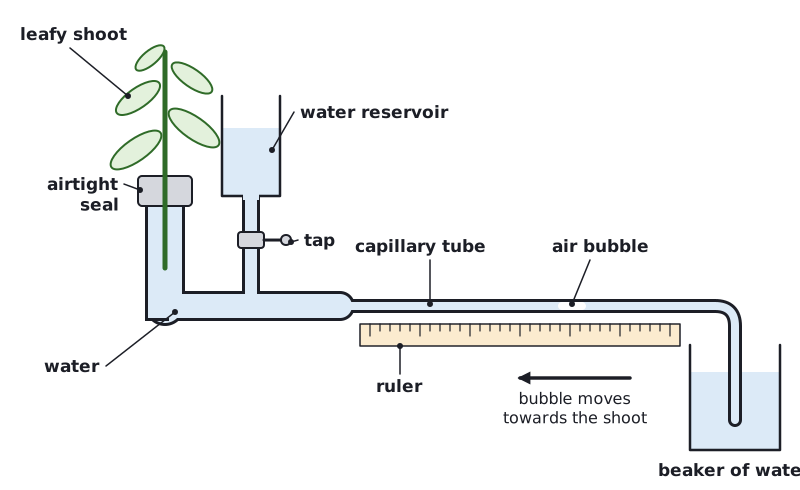
A potometer measures how much water a cut shoot takes up. Almost all the water taken up is lost by transpiration, so uptake is used to measure the rate of transpiration.
- Cut a leafy shoot under water, so no air enters the xylem, and fit it into the potometer under water.
- Make sure the apparatus is full of water, with no air bubbles, and that the joints are airtight.
- Dry the leaves, then introduce one air bubble into the capillary tube and record its starting position.
- Measure the distance the bubble moves in a set time.
- Change one factor (for example switch on a fan), keep the others the same and repeat. Calculate the mean of repeats.
Independent variable: one environmental factor, for example wind speed (fan distance), light (lamp distance), temperature or humidity (plastic bag over the shoot). Control the other factors, the same shoot size and the time. Safety: cut the shoot with care, and keep electrical equipment away from water. Expected results: the bubble moves further in a set time when it is warm, windy or bright, and less in humid air. You can also weigh the shoot and its container: the faster the mass falls, the higher the rate.
 (opens full size in a new tab)
Rate of water uptake
An air bubble in a potometer moves 36 mm in 12 minutes. Calculate the rate of water uptake in mm per minute.
- Rate = distance ÷ time.
- Rate = 36 ÷ 12.
Answer: 3 mm/min
Volume of water taken up
The capillary tube has a cross-sectional area of 0.8 mm². The bubble moves 40 mm in 10 minutes. Calculate the rate of water uptake in mm³ per minute.
- Volume = cross-sectional area × distance = 0.8 × 40 = 32 mm³.
- Rate = volume ÷ time = 32 ÷ 10.
Answer: 3.2 mm³/min
Give the unit with every rate. Repeat readings and find the mean to reduce the effect of random errors.
Quick check
Why can a unicellular organism rely on diffusion?
Show answer
It has a large surface area compared with its volume, so diffusion distances are short.
Which tissue carries water and mineral ions from the roots?
Show answer
Xylem.
Which substances does phloem transport?
Show answer
Sucrose and amino acids.
Biology only Define transpiration.
Show answer
The evaporation of water from the surface of a plant.
Biology only How does an increase in humidity affect the rate of transpiration?
Show answer
It decreases the rate, because the concentration gradient of water vapour is smaller.