

Viruses and pathogensSpec 1.4
A pathogen is an organism or particle that causes disease. Pathogens may include fungi, bacteria, protoctists or viruses.
Viruses
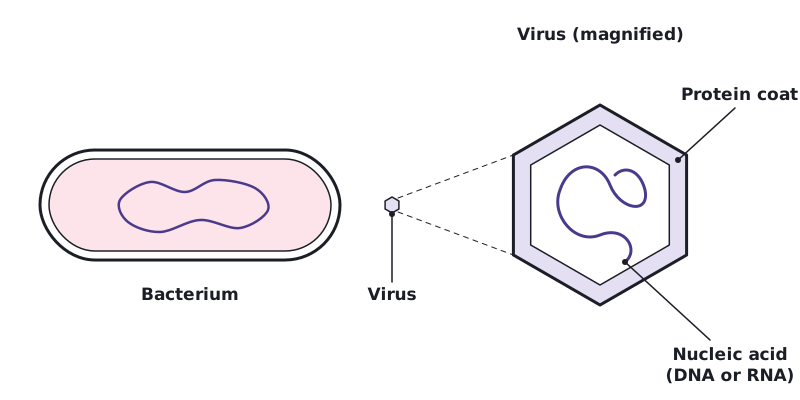
Viruses are not living organisms. They are small particles, smaller than bacteria, and they have a wide variety of shapes and sizes.
- They have no cellular structure.
- They have a protein coat and contain one type of nucleic acid, either DNA or RNA.
- They are parasitic: they can reproduce only inside living cells.
- They infect every type of living organism.
 (opens full size in a new tab)
| Virus | Disease or effect |
|---|---|
| Tobacco mosaic virus | Discolours the leaves of tobacco plants by preventing the formation of chloroplasts |
| Influenza virus | Causes flu |
| HIV | Causes AIDS |
| Type of pathogen | Example | Disease |
|---|---|---|
| Virus | HIV | AIDS |
| Bacterium | Pneumococcus | Pneumonia |
| Protoctist | Plasmodium | Malaria |
Say that viruses 'reproduce only inside living cells' and that they have 'no cellular structure'. These are the usual mark-scheme points for why a virus is not a living organism.
Quick check
Give any four characteristics shared by all living organisms.
Show answer
Any four from: nutrition, respiration, excretion, response to surroundings, movement, control of internal conditions, reproduction, growth and development.
What are fungal cell walls made of?
Show answer
Chitin.
What is the name for the thread-like structures that make up a fungal mycelium?
Show answer
Hyphae.
Give two features of a bacterial cell.
Show answer
Any two from: cell wall, cell membrane, cytoplasm, plasmids, circular chromosome of DNA, no nucleus.
Why are viruses not classed as living organisms?
Show answer
They have no cellular structure and can reproduce only inside living cells.