
Practical: carbon dioxide and heat from respiring seedsSpec 2.39
In short
Germinating seeds can be used to show that respiration releases heat and carbon dioxide. Living seeds in a vacuum flask make the temperature rise, and they turn hydrogen-carbonate indicator from red/orange to yellow or limewater cloudy. Boiled, dead seeds are the control: they show no change, proving the effects are caused by living seeds respiring.
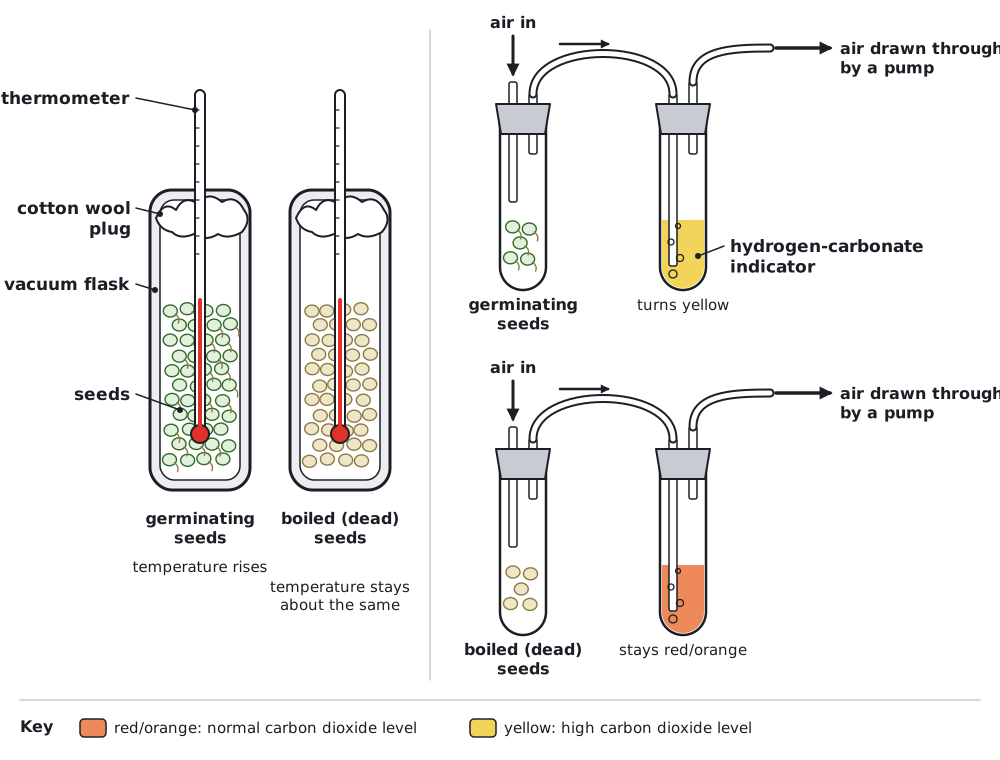
Respiring organisms release carbon dioxide and heat. You can show both with germinating seeds, which respire quickly as they grow. A second set of seeds that have been boiled (and so are dead) acts as the control.
Heat released
- Soak some seeds, such as peas, so that they start to germinate. Boil a second batch to kill them, then let them cool to room temperature.
- Rinse both batches in a weak disinfectant solution. This kills microorganisms that would also respire.
- Put the living seeds in one vacuum flask (which reduces heat loss) and the boiled seeds in another. Put a thermometer in each flask and plug the top with cotton wool.
- Use the same mass of seeds in each flask and start both at the same temperature.
- Record the temperature of each flask at the start and then at regular intervals, for example every day for several days.
Carbon dioxide released
- Set up a tube of germinating seeds and a tube of boiled seeds, each connected to a tube of hydrogen-carbonate indicator (or limewater). Alternatively, hold the seeds on gauze above the indicator in a sealed tube.
- If the tubes are connected, draw air through each set of apparatus with a pump or syringe, so that any carbon dioxide released by the seeds bubbles through the indicator.
- Record the colour of the indicator after a set time.
| Type of variable | Example |
|---|---|
| Independent variable | Living seeds or boiled seeds |
| Dependent variable | Temperature of the flask, or the colour of the indicator |
| Control variables | Mass of seeds, starting temperature, volume of indicator, volume of air drawn through, time |
| Test | Living seeds | Boiled seeds |
|---|---|---|
| Temperature | Rises, because respiration releases heat | Stays about the same |
| Hydrogen-carbonate indicator | Changes from red/orange to yellow (carbon dioxide released) | Stays red/orange |
| Limewater | Turns cloudy | Stays clear |
Wash your hands after handling seeds and disinfectant, and wear eye protection. Limewater is an irritant. The boiled seeds are the control because they show that the changes are caused by living seeds, not by the apparatus.
 (opens full size in a new tab)
Quick check
What is the name of the molecule that provides energy for cells?
Show answer
ATP (adenosine triphosphate).
State the word equation for aerobic respiration.
Show answer
glucose + oxygen → carbon dioxide + water.
What is made in anaerobic respiration in animals?
Show answer
Lactic acid.
What is made in anaerobic respiration in plants?
Show answer
Ethanol and carbon dioxide.
Why are boiled seeds used as a control in the respiring seeds practical?
Show answer
They are dead, so they show that any changes are caused by living seeds respiring.
Written and checked against the Edexcel IGCSE Science Double Award (4SD0) specification · Updated October 2026