Edexcel International GCSE Science (Double Award), topic 2
Structure and functions in living organisms
This topic is about how living organisms are built and how they work. It starts with cells, the molecules and enzymes inside them and how substances move in and out. It then follows the life processes of flowering plants and humans: nutrition, respiration, gas exchange, transport, excretion, and co-ordination and response.
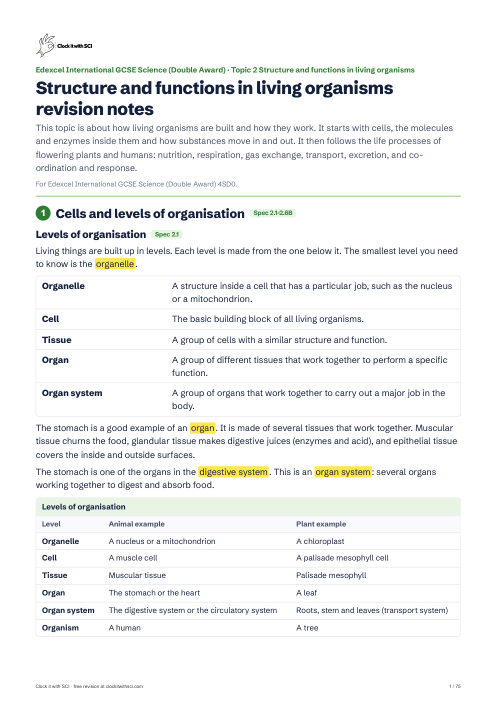 Revision notes
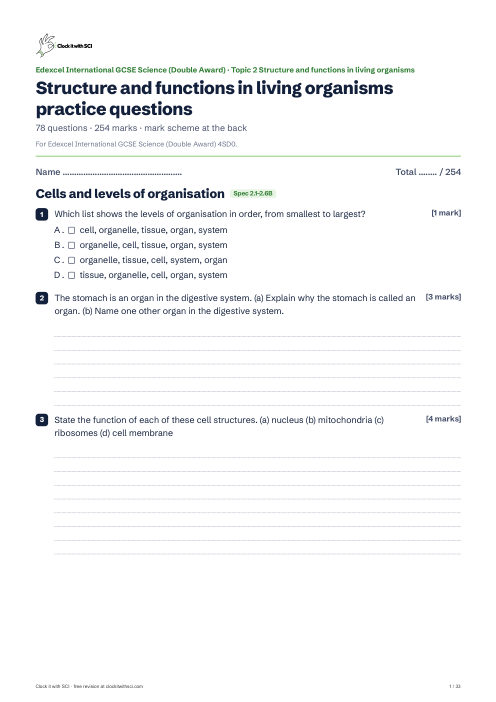 Worksheet
 Flashcards
Subtopics
Work through them in order. Each one has notes, exam questions and flashcards, and a PDF of each. Biology-only subtopics are left out.
- 1Cells and levels of organisation Spec 2.1–2.6BLevels of organisation from organelles to organisms, and the structures of plant and animal cells and what they do.NotesQuestions 4Flashcards 9
- 2Biological molecules and enzymes Spec 2.7–2.14BThe elements and building blocks of carbohydrates, proteins and lipids, food tests, and how temperature and pH affect enzymes.NotesQuestions 6Flashcards 15
- 3Movement of substances into and out of cells Spec 2.15–2.17Diffusion, osmosis and active transport, what affects their rate, and practicals using living and non-living systems.NotesQuestions 7Flashcards 12
- 4Nutrition in flowering plants Spec 2.18–2.23How plants make glucose by photosynthesis, what affects its rate, how the leaf is adapted, and the practical work.NotesQuestions 6Flashcards 18
- 5Human nutrition Spec 2.24–2.33BA balanced diet, nutrient sources and functions, the alimentary canal and peristalsis, digestive enzymes, bile and absorption in the small intestine.NotesQuestions 6Flashcards 23
- 6Respiration Spec 2.34–2.39How respiration releases energy from glucose to make ATP, aerobic and anaerobic respiration, and the seed practical.NotesQuestions 6Flashcards 11
- 7Gas exchange in flowering plants Spec 2.40B, 2.41B, 2.43B–2.45B, 2.70Carbon dioxide and oxygen as the waste products of respiration and photosynthesis in plants.NotesQuestions 1Flashcards 1
- 8Gas exchange in humans Spec 2.46–2.50The structure of the thorax, how ventilation works, how alveoli are adapted, the effects of smoking and the breathing practical.NotesQuestions 7Flashcards 13
- 9The need for transport and transport in plants Spec 2.51–2.58BWhy large organisms need transport systems, and how xylem carries water and mineral ions and phloem carries sucrose and amino acids.NotesQuestions 3Flashcards 6
- 10Blood and the immune system Spec 2.59–2.64BThe components of blood, what plasma transports, how red blood cells carry oxygen, and how phagocytes and lymphocytes defend the body.NotesQuestions 5Flashcards 9
- 11The heart and circulation Spec 2.65–2.69Heart structure and function, heart rate and adrenaline, coronary heart disease, blood vessels and the circulation of blood around the body.NotesQuestions 7Flashcards 15
- 12Excretion Spec 2.71–2.79BWhat excretion is, and the excretory products of the lungs, kidneys and skin, such as carbon dioxide and urea.NotesQuestions 2Flashcards 4
- 13Coordination, homeostasis and plant responses Spec 2.80–2.85How organisms respond to change using a stimulus, receptor and effector, what homeostasis is, and how plants respond to light and gravity.NotesQuestions 6Flashcards 9
- 14The nervous system and the eye Spec 2.87–2.92The central nervous system, nerve impulses, synapses, the reflex arc, and the structure and function of the eye.NotesQuestions 7Flashcards 14
- 15Hormones and temperature control Spec 2.86, 2.93–2.95BHow nervous and hormonal communication differ, the sources and roles of adrenaline, insulin and the sex hormones, and temperature control by the skin.NotesQuestions 5Flashcards 10
Whole topic
When you have done the subtopics: test yourself on everything, or print the lot.