
Factors affecting the rate of movementSpec 2.16
In short
Four factors affect how fast substances move into and out of cells: surface area to volume ratio, distance, temperature and concentration gradient. A larger surface area to volume ratio, a shorter distance, a higher temperature and a steeper concentration gradient all increase the rate. As an organism gets bigger, its surface area to volume ratio gets smaller.
Four factors affect how fast substances move into and out of cells by diffusion and osmosis.
| Factor | Effect on the rate | Example |
|---|---|---|
| Surface area to volume ratio | A larger ratio means a faster rate for the size of the cell, because more surface is available for each unit of volume | Root hair cells have a long projection that gives a large surface area |
| Distance | A shorter distance means a faster rate | The wall of an alveolus is one cell thick |
| Temperature | A higher temperature means a faster rate, because particles have more kinetic energy and move faster | Diffusion is faster in a warm solution than in a cold one |
| Concentration gradient | A steeper gradient (a bigger difference in concentration) means a faster rate | Blood flow keeps the oxygen concentration lower in the blood than in the alveoli |
Surface area to volume ratio
The surface area : volume ratio tells you how much surface an organism or cell has compared with its size. The bigger the object, the smaller this ratio becomes.
Surface area : volume ratio of a cube
A cube-shaped block of tissue has sides of 3 cm. Calculate its surface area : volume ratio.
- A cube has 6 faces. Area of one face = 3 × 3 = 9 cm².
- Surface area = 6 × 9 = 54 cm².
- Volume = 3 × 3 × 3 = 27 cm³.
- Ratio = 54 : 27. Divide both sides by 27.
Answer: 2 : 1
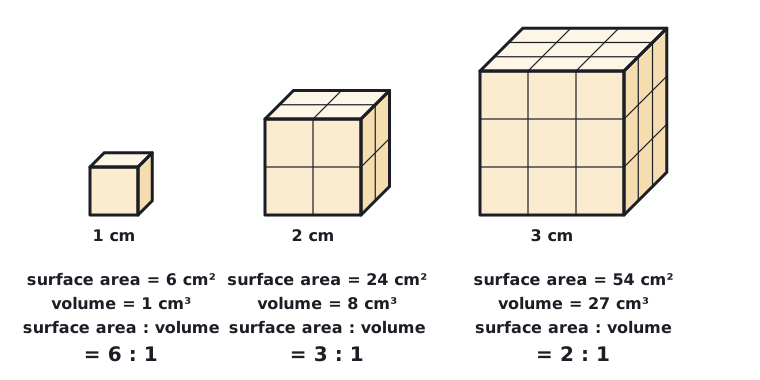 (opens full size in a new tab)
- A single-celled organism has a large surface area : volume ratio. Substances only have a short distance to diffuse, so diffusion across the surface is fast enough.
- A multicellular organism has a small surface area : volume ratio. Many cells are deep inside the body, so the diffusion distance is long and diffusion across the body surface is too slow.
A thin membrane or wall gives a short diffusion distance. It does not give a larger surface area: these are two separate factors.
Written and checked against the Edexcel IGCSE Science Double Award (4SD0) specification · Updated October 2026