
Book a tutor

Population, community, habitat and ecosystem

Ecology and the environment · The organism in the environment · note 1 of 4

Population, community, habitat and ecosystemSpec 4.1

In short

A population is all the organisms of one species living in the same area, and a community is all the populations of different species living there. A habitat is the place where an organism lives. An ecosystem is a community together with the non-living, or abiotic, parts of its environment, such as soil, water, light and temperature.

Ecologists use four key terms to describe living things and where they live. Each one covers a bigger scale than the one before.

Key ecological terms
TermWhat it meansExample
PopulationAll the organisms of one species living in the same areaAll the badgers in a wood
CommunityAll the populations of different species living in the same areaThe badgers, foxes, oak trees, insects and fungi in the wood
HabitatThe place where an organism livesThe woodland floor, or a pond
EcosystemA community together with the non-living (abiotic) parts of its environmentThe wood, including its soil, water, light and temperature

An ecosystem is made of living (biotic) and non-living (abiotic) parts that interact with each other. Energy and materials move between them.

Common mistake:

A population is one species only. If an answer mentions different species living together, it is describing a community.
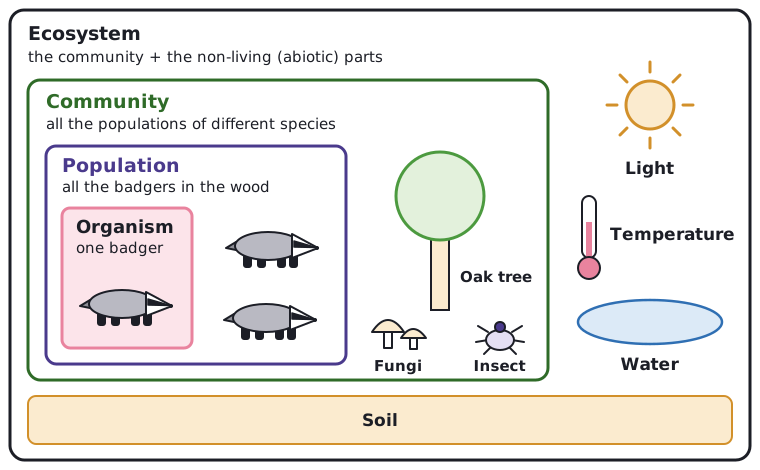
Nested boxes showing the levels of organisation in a wood: one badger (organism) inside all the badgers (population), inside the community with an oak tree, fungi and an insect, inside the ecosystem with light, temperature, water and soil. (opens full size in a new tab)
Each level contains the one before it: organism, population, community, then ecosystem (the community plus its abiotic parts).

Written and checked against the Edexcel IGCSE Science Double Award (4SD0) specification · Updated October 2026

Frequently asked questions

What is the difference between a population and a community?

A population is all the organisms of one species living in the same area, such as all the badgers in a wood. A community is all the populations of different species living in that area, such as the badgers, foxes, oak trees, insects and fungi. If more than one species is mentioned, it is a community.

How do you estimate population size using quadrats?

Place quadrats randomly, count the organisms in each and calculate the mean number per quadrat. Then multiply the mean by the total area divided by the area of one quadrat. For example, a mean of 4 per 0.25 m² quadrat in a 100 m² field gives an estimate of 4 × 400 = 1600.

Why are quadrats placed randomly and how many should you use?

Quadrats are placed randomly, using coordinates from a random number generator, so the sample is not biased by the person choosing where to put them. You should use as many as possible, at least 10, because a bigger sample is more representative, reduces the effect of anomalies and gives a more reliable mean.

All 4 questions on The organism in the environment