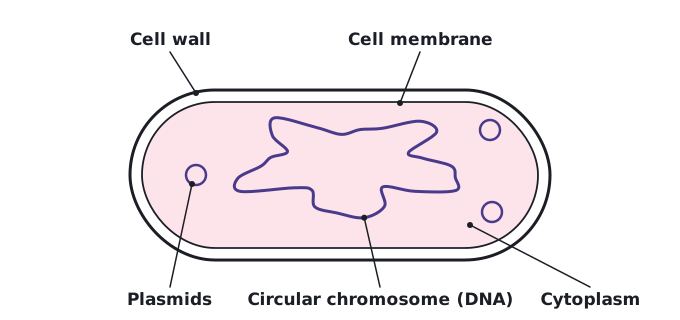
Bacteria are microscopic, single-celled prokaryotic organisms with no nucleus. A bacterial cell has a cell wall, cell membrane and cytoplasm, and its DNA is a circular chromosome found free in the cytoplasm, along with small rings of DNA called plasmids. Lactobacillus bulgaricus is used to make yoghurt, while Pneumococcus is a pathogen that causes pneumonia.
Bacteria are prokaryotic organisms. They are microscopic and single-celled, and they do not have a nucleus.
Cell wall
Surrounds the cell and supports it.
Cell membrane
Controls the movement of substances into and out of the cell.
Cytoplasm
Where the chemical reactions of the cell happen.
Circular chromosome
A single loop of DNA found free in the cytoplasm, not enclosed in a nucleus.
Plasmids
Small rings of extra DNA, separate from the circular chromosome.
Most bacteria feed off other living or dead organisms. Some bacteria can carry out photosynthesis.
Two examples of bacteria
Bacterium
Shape
Importance
Lactobacillus bulgaricus
Rod-shaped
Used in the production of yoghurt from milk
Pneumococcus
Spherical
A pathogen that causes pneumonia
Common mistake:
Bacteria do have DNA. Write that it is not in a nucleus, never that bacteria have no DNA.
Written and checked against the Edexcel IGCSE Science Double Award (4SD0) specification · Updated October 2026
Frequently asked questions
What are the eight characteristics of living organisms?
The eight characteristics are nutrition, respiration, excretion, response to surroundings, movement, control of internal conditions, reproduction, and growth and development. All living organisms show every one of them, although in different ways. A plant, for example, moves by growing towards light, while an animal can move from place to place.
What is the difference between excretion and egestion?
Excretion is removing the waste products made by chemical reactions in cells, such as carbon dioxide. Egestion is removing undigested food from the gut. Only excretion is one of the characteristics of living organisms, so in an exam do not use the two words as if they mean the same thing.
What is the difference between prokaryotic and eukaryotic cells?
Prokaryotic cells, such as bacteria, have no nucleus: their DNA is a circular chromosome free in the cytoplasm, often with extra rings called plasmids. Eukaryotic cells, found in plants, animals, fungi and protoctists, have their DNA enclosed in a nucleus. Bacteria are also microscopic and single-celled, while many eukaryotes are multicellular.

 (opens full size in a new tab)