

The structure of DNASpec 3.4
DNA is a polymer made up of many repeating units called nucleotides. A polymer is a long molecule made of many similar smaller units joined together.
- DNA is made of two strands coiled to form a double helix.
- Each nucleotide consists of a sugar and a phosphate group, with one of four different bases attached to the sugar.
- The two strands are linked by a series of complementary base pairs, joined together by weak hydrogen bonds.
| Base | Pairs with |
|---|---|
| Adenine (A) | Thymine (T) |
| Thymine (T) | Adenine (A) |
| Cytosine (C) | Guanine (G) |
| Guanine (G) | Cytosine (C) |
Because A always pairs with T and C always pairs with G, the base sequence on one strand tells you the sequence on the other. If one strand reads A T G C, the complementary strand reads T A C G.
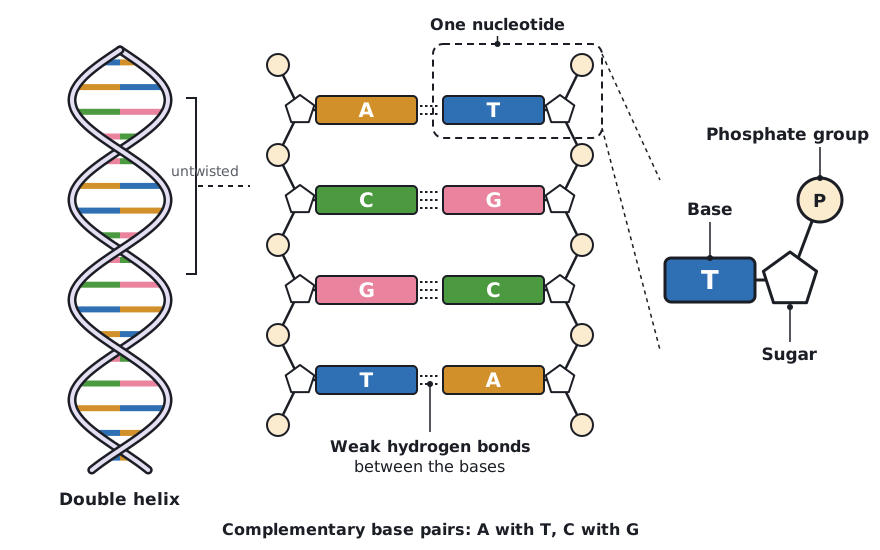 Tap to enlarge
The genome and genesSpec 3.5
- Genome
- The entire DNA of an organism.
- Gene
- A section of a DNA molecule that codes for a specific protein.
The genome includes all of the genes of an organism. A gene is a short section of the DNA. Each gene has a different sequence of bases and so codes for a different protein.
Extracting DNA from fruitSpec 3.6
DNA can be extracted from the cells of fruit such as strawberries or kiwi fruit using simple equipment. Each step has a purpose.
- Mash the fruit in a beaker. This breaks the fruit into small pieces and separates the cells.
- Add a mixture of detergent and salt, and stir. The detergent breaks down the cell membranes (and the nuclear membranes) so the DNA is released. The salt helps the DNA to clump together.
- Filter the mixture. This removes the solid pieces of cell, and the filtrate contains the DNA.
- Carefully add ice-cold ethanol so that it forms a layer on top of the filtrate.
- Look at the boundary between the layers. DNA is not soluble in cold ethanol, so it comes out of solution as white, stringy strands. These can be lifted out with a glass rod.
Quick check
What are the two strands of DNA coiled into?
Show answer
A double helix.
Which bases pair together in DNA?
Show answer
A with T, and C with G.
What is a gene?
Show answer
A section of a DNA molecule that codes for a specific protein.
What is the purpose of the detergent when extracting DNA from fruit?
Show answer
It breaks down the cell membranes to release the DNA.