

What is a pathogen?Spec 5.4
A pathogen is a disease-causing organism. The four types you need to know are viruses, bacteria, fungi and protists.
| Type | Key facts | Example |
|---|---|---|
| Virus | Not a cell; much smaller than bacteria; can only reproduce inside a host cell | HIV |
| Bacterium | A single-celled organism with no nucleus | Cholera bacterium |
| Fungus | Includes single-celled and many-celled organisms | Chalara ash dieback fungus |
| Protist | A single-celled organism with a nucleus | Malaria protist |
Common infectionsSpec 5.5
| Disease | Pathogen type | Effect on the host |
|---|---|---|
| Cholera | Bacterium | Causes diarrhoea |
| Tuberculosis | Bacterium | Causes lung damage |
| Chalara ash dieback | Fungus | Causes leaf loss and bark lesions in ash trees |
| Malaria | Protist | Causes damage to the blood and liver |
| HIV | Virus | Destroys white blood cells, leading to the onset of AIDS |
| Disease | Pathogen type | Effect on the host |
|---|---|---|
| Stomach ulcers (Helicobacter) | Bacterium | Causes stomach ulcers |
| Ebola | Virus | Causes haemorrhagic fever |
Haemorrhagic fever means a fever with bleeding.
How pathogens spread and how to control themSpec 5.6
To explain how to reduce the spread of a disease, first state how it is spread, then say how that route can be blocked.
| Disease | How it spreads | How spread can be reduced or prevented |
|---|---|---|
| Cholera (bacteria) | In water contaminated with sewage containing the bacteria | Provide clean drinking water; treat sewage; wash hands and cook food thoroughly |
| Tuberculosis (bacteria) | Airborne: droplets from coughs and sneezes | Isolate infected people; cover the mouth when coughing; good ventilation; vaccination |
| Chalara ash dieback (fungi) | Airborne spores carried by the wind | Destroy infected trees; restrict movement and import of ash plants |
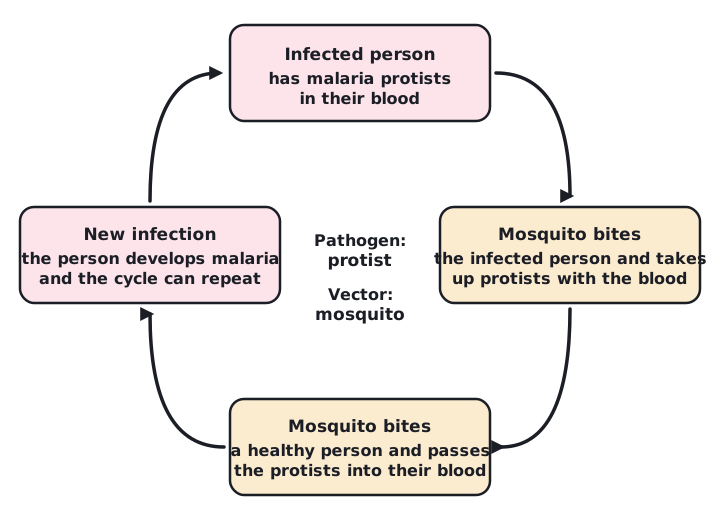
| Malaria (protists) | By an animal vector: the mosquito, which carries the protist from person to person | Control mosquitoes (drain standing water, use insecticides); mosquito nets; insect repellent |
| Disease | How it spreads | How spread can be reduced or prevented |
|---|---|---|
| Stomach ulcers, Helicobacter (bacteria) | Oral transmission: swallowing the bacteria in food, water or from saliva | Good hygiene; handwashing; clean water and food preparation |
| Ebola (virus) | Contact with infected body fluids | Isolate patients; wear protective clothing; avoid contact with body fluids, including safe handling of bodies |
A vector is an organism that carries a pathogen from one host to another without usually being harmed itself. The malaria vector is the mosquito. Killing or avoiding the vector breaks the chain.
 Tap to enlarge
The lifecycle of a virusSpec 5.7BTriple only
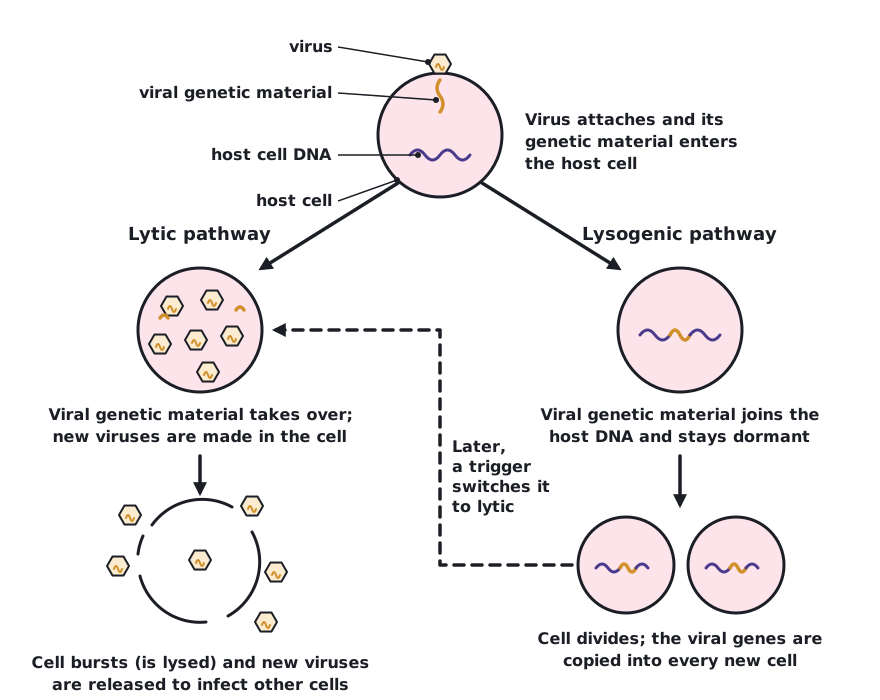
Viruses are not cells and cannot reproduce on their own. They reproduce inside a host cell, using the host's cell machinery. A virus can follow one of two pathways.
The lytic pathway
- The virus attaches to a host cell and its genetic material enters the cell.
- The viral genetic material takes over the host cell and the cell makes new virus parts.
- New viruses are assembled inside the cell.
- The cell bursts open (it is lysed) and the new viruses are released to infect other cells.
The lysogenic pathway
- The virus attaches and its genetic material enters the host cell.
- The viral genetic material becomes part of the host cell's DNA.
- The virus stays dormant (inactive). The host cell does not burst and does not show harm. When the host cell divides, the viral genetic material is copied too, so every new cell contains it.
- At a later time, something may trigger the viral genetic material to become active, and the virus then follows the lytic pathway.
| Lytic | Lysogenic | |
|---|---|---|
| Viral genetic material | Takes over the cell straight away | Joins the host DNA and stays inactive |
| New viruses made? | Yes, immediately | Not until the virus becomes active |
| Host cell | Burst open and killed | Survives and divides, copying the viral genes |
 Tap to enlarge
Sexually transmitted infectionsSpec 5.8
Sexually transmitted infections (STIs) are spread by sexual contact. You need two examples: chlamydia and HIV.
| Chlamydia | HIV | |
|---|---|---|
| Pathogen | Bacterium | Virus |
| How it spreads | Unprotected sexual contact | Unprotected sexual contact; sharing needles; contact with infected blood; from an infected mother to her baby |
| Effects | Often no symptoms; can cause infertility | Destroys white blood cells and can lead to AIDS |
| How spread can be reduced | Use condoms; screening and testing; treating infected people with antibiotics; informing partners | Use condoms; do not share needles; screen donated blood; drug treatment to lower the amount of virus |
Condoms act as a barrier that stops body fluids passing from one person to another. Using a condom, having fewer partners and being tested regularly all reduce the spread.
Quick check
Name the four types of pathogen.
Show answer
Viruses, bacteria, fungi and protists.
How is cholera spread, and how can its spread be reduced?
Show answer
Through contaminated water; provide clean water and treat sewage.
What is the vector for malaria?
Show answer
The mosquito.
Triple only: what happens to the host cell in the lytic pathway?
Show answer
It bursts open (lyses), releasing new viruses.
Name a bacterial STI and a viral STI.
Show answer
Chlamydia (bacterial) and HIV (viral).