

How enzymes workSpec 1.7
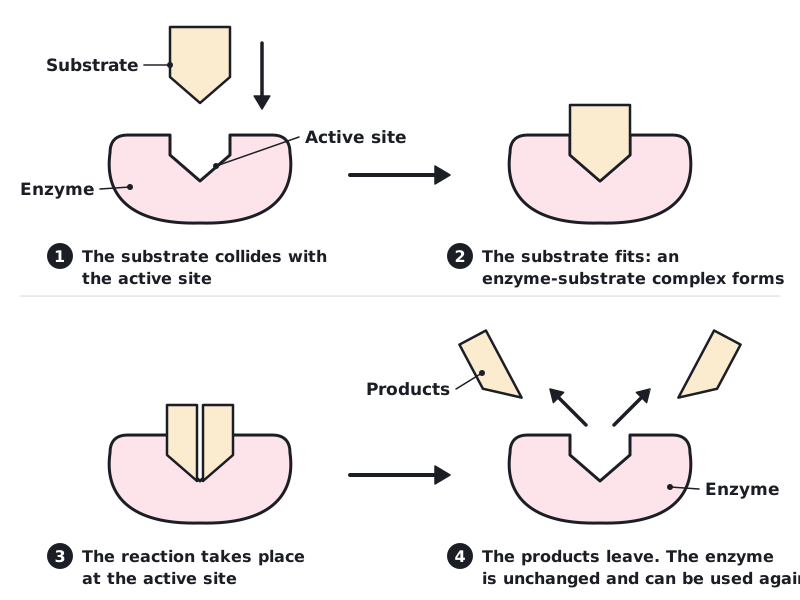
Enzymes are proteins that act as biological catalysts. A catalyst speeds up a reaction without being used up. Each enzyme has a region called the active site, which has a particular shape.
The molecule an enzyme acts on is called the substrate. The substrate has a shape that is complementary to the active site, so it fits in, like a key in a lock. This is called the lock and key model.
- The substrate collides with the active site of the enzyme.
- The substrate fits into the active site, forming an enzyme-substrate complex.
- The reaction takes place at the active site.
- The product or products leave the active site and the enzyme is free to be used again.
Enzymes are specific. Only a substrate with a shape that fits the active site can bind to it, so each enzyme catalyses only one type of reaction.
 Tap to enlarge
Denaturing enzymesSpec 1.8
If the temperature is too high, or the pH is too far from the enzyme's optimum, the bonds that hold the enzyme in shape are broken. The enzyme changes shape, and so does the active site.
The substrate no longer fits the active site, so the enzyme cannot catalyse the reaction. The enzyme is denatured. This change is permanent.
Temperature, substrate concentration and pHSpec 1.9
Temperature
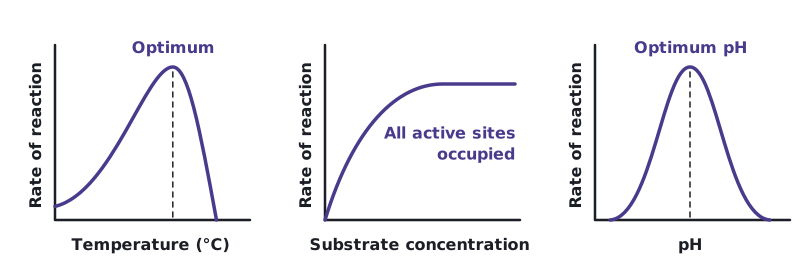
As temperature increases, the particles move faster and have more kinetic energy. Enzyme and substrate collide more often, so the rate of reaction increases. The rate is highest at the optimum temperature, which is around 37 °C for many human enzymes. Above the optimum, the active site changes shape, the enzyme is denatured and the rate falls quickly towards zero.
Substrate concentration
At low substrate concentration, increasing it makes the rate increase, because collisions between substrate and active sites are more frequent. Eventually all the active sites are occupied at once. Adding more substrate then has no effect, so the rate levels off. The enzyme concentration is now limiting the rate.
pH
Each enzyme has an optimum pH where it works fastest. If the pH is higher or lower than the optimum the rate decreases, and at extreme pH values the active site changes shape and the enzyme is denatured. Different enzymes have different optimum pH values.
 Tap to enlarge
| Factor | Below the optimum / low | At the optimum | Above the optimum / high |
|---|---|---|---|
| Temperature | Rate increases as particles move faster and collide more often | Highest rate | Enzyme denatured, rate falls |
| pH | Rate decreases as pH moves away from the optimum, and the enzyme is denatured at extreme pH | Highest rate | Rate decreases as pH moves away from the optimum, and the enzyme is denatured at extreme pH |
| Substrate concentration | Rate increases | Not applicable | Rate stops increasing when all active sites are occupied |
Core practical: the effect of pH on enzyme activitySpec 1.10
A common version of this investigation uses amylase, an enzyme that breaks down starch, and iodine solution to show when the starch has gone.
- Put drops of iodine solution into the wells of a spotting tile.
- Add starch solution and a buffer solution of a known pH to a test tube. Put this tube, and a tube of amylase solution, in a water bath at a set temperature (for example 35 °C) for a few minutes.
- Add the amylase solution to the starch and buffer, mix and start the stopwatch.
- At regular intervals, for example every 30 seconds, use a dropping pipette to add a drop of the mixture to a well of iodine solution.
- Record the time when the iodine solution stops turning blue-black and stays orange-brown. This shows all the starch has been broken down.
- Repeat for buffer solutions of different pH values, and repeat each pH to calculate a mean.
| Variable | How it is controlled |
|---|---|
| Temperature | Use a water bath |
| Volume and concentration of enzyme | Use the same amount of the same solution each time |
| Volume and concentration of starch | Use the same amount of the same solution each time |
Typical results: the shortest time is at the optimum pH, where the enzyme works fastest. Times get longer at pH values further from the optimum. Plot the rate (or time) against pH on a graph and draw a smooth curve through the points. Wear eye protection, because iodine solution and some buffers are irritants, and wipe up any spills.
Rate calculations for enzyme activitySpec 1.11
The rate of reaction tells you how fast a reaction is happening. It is a compound measure, because it combines an amount with a time.
The units depend on what you measure, for example cm³/s for a volume of gas, or g/min for a mass. If an experiment measures the time taken for a reaction to finish, such as the time for starch to disappear, the rate can be found as 1 ÷ time, with units of s⁻¹.
Calculating a rate
An enzyme produces 12 cm³ of gas in 40 seconds. Calculate the rate of reaction in cm³/s.
- rate = amount of product ÷ time
- 12 ÷ 40 = 0.3
Answer: 0.3 cm³/s
Quick check
What is the name of the part of an enzyme that the substrate fits into?
Show answer
The active site.
Why does an enzyme stop working at a high temperature?
Show answer
The shape of the active site changes, so the substrate no longer fits. The enzyme is denatured.
Why does the rate level off as substrate concentration increases?
Show answer
All the active sites are occupied.
In the pH core practical, what colour shows that starch is still present with iodine solution?
Show answer
Blue-black.
Calculate the rate when 30 cm³ of gas is collected in 60 s.
Show answer
0.5 cm³/s.