

DiffusionSpec 1.15
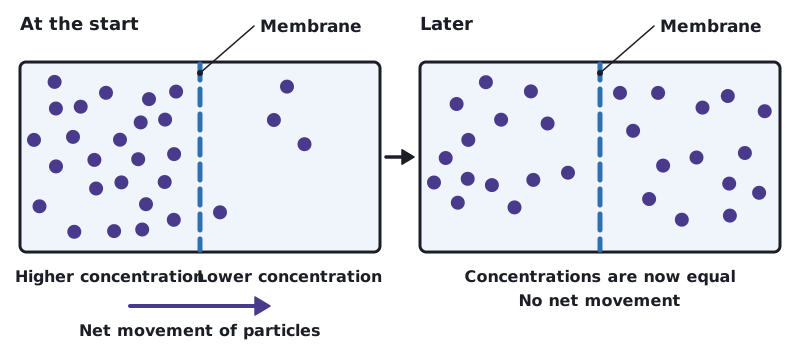
Diffusion is the net movement of particles from an area of higher concentration to an area of lower concentration. The particles move down a concentration gradient. It is a passive process, so it does not need energy from respiration.
Oxygen, carbon dioxide and dissolved substances can diffuse into and out of cells through the cell membrane. The rate of diffusion is higher when:
- the concentration gradient is steeper, because there is a bigger difference in concentration
- the temperature is higher, because particles have more kinetic energy and move faster
- the surface area is larger, because more particles can cross at once
 Tap to enlarge
OsmosisSpec 1.15
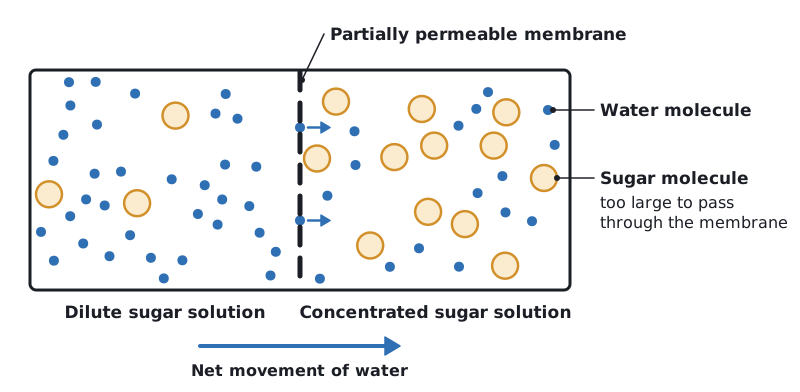
Osmosis is the diffusion of water from a dilute solution to a more concentrated solution through a partially permeable membrane. A partially permeable membrane lets small molecules such as water through, but not larger molecules.
Osmosis is a passive process. It does not need energy from respiration.
 Tap to enlarge
Active transportSpec 1.15
Active transport is the movement of substances from a more dilute solution to a more concentrated solution, which is against a concentration gradient. It needs energy from respiration.
Active transport allows cells to take in substances they need even when they are in short supply outside the cell. For example, root hair cells take in mineral ions from the soil when the concentration of the ions is higher inside the cell than in the soil.
| What moves | Direction | Energy from respiration? | |
|---|---|---|---|
| Diffusion | Particles, such as oxygen and carbon dioxide | High to low concentration | No |
| Osmosis | Water only, through a partially permeable membrane | Dilute to concentrated solution | No |
| Active transport | Substances such as mineral ions | Low to high concentration, against the gradient | Yes |
Core practical: osmosis in potatoesSpec 1.16
Potato cells gain or lose water by osmosis depending on the concentration of the solution around them. You can measure this as a change in mass.
- Use a cork borer to cut cylinders from one potato, and trim them to the same length.
- Measure and record the mass of each cylinder.
- Put each cylinder in a different concentration of sugar (or salt) solution, including pure water, using the same volume of solution each time.
- Leave them for the same length of time at the same temperature.
- Remove the cylinders, blot them dry with paper towel and measure their final mass.
- Calculate the percentage change in mass for each cylinder and plot a graph of percentage change against concentration.
| Result | Explanation |
|---|---|
| Mass increases | The solution is more dilute than the cell contents, so water moves into the potato by osmosis |
| Mass decreases | The solution is more concentrated than the cell contents, so water moves out of the potato by osmosis |
| No change in mass | The solution has the same concentration as the cell contents, so there is no net movement of water |
Where the graph line crosses the x-axis (0% change), the concentration of the solution equals the concentration of the potato cell contents. Control the potato, the size of the cylinders, the volume of the solution, the time and the temperature. Repeat the experiment and calculate a mean. Cut on a tile away from your fingers, because cork borers and scalpels are sharp.
Percentage gain and loss of massSpec 1.17
Different cylinders may start with slightly different masses, so you compare them using the percentage change in mass.
A positive answer is a percentage gain. A negative answer is a percentage loss.
Percentage change in mass
A potato cylinder has a mass of 3.00 g. After 30 minutes in a salt solution its mass is 2.55 g. Calculate the percentage change in mass.
- change in mass = 2.55 − 3.00 = −0.45 g
- −0.45 ÷ 3.00 = −0.15
- −0.15 × 100 = −15%
Answer: −15% (a loss of 15%)
Quick check
Define diffusion.
Show answer
The net movement of particles from a region of higher concentration to a region of lower concentration.
Define osmosis.
Show answer
The diffusion of water from a dilute solution to a more concentrated solution through a partially permeable membrane.
What does active transport need that diffusion does not?
Show answer
Energy from respiration.
A potato cylinder gains mass in a solution. What does this tell you about the solution?
Show answer
It is more dilute than the cell contents.
Write the equation for percentage change in mass.
Show answer
(final mass − initial mass) ÷ initial mass × 100.