

The cell cycle and mitosisSpec 2.1
Cells grow and divide in a repeating sequence called the cell cycle. Most of the cycle is interphase, when the cell is not dividing. Mitosis is the part of the cycle in which the nucleus divides. It is followed by cytokinesis, when the cytoplasm and cell membrane divide.
| Stage | What happens |
|---|---|
| Interphase | The cell grows and makes more of its sub-cellular structures. The DNA is copied, so each chromosome is made of two identical copies (chromatids). |
| Prophase | The chromosomes become shorter and thicker, so they can be seen. The membrane around the nucleus breaks down. |
| Metaphase | The chromosomes line up along the middle (the equator) of the cell. They are attached to spindle fibres. |
| Anaphase | The spindle fibres pull the two copies of each chromosome apart, to opposite ends of the cell. |
| Telophase | A new nuclear membrane forms around each set of chromosomes, so there are two nuclei. |
| Cytokinesis | The cytoplasm and cell membrane divide to make two separate cells. |
The order is interphase, prophase, metaphase, anaphase, telophase, then cytokinesis.
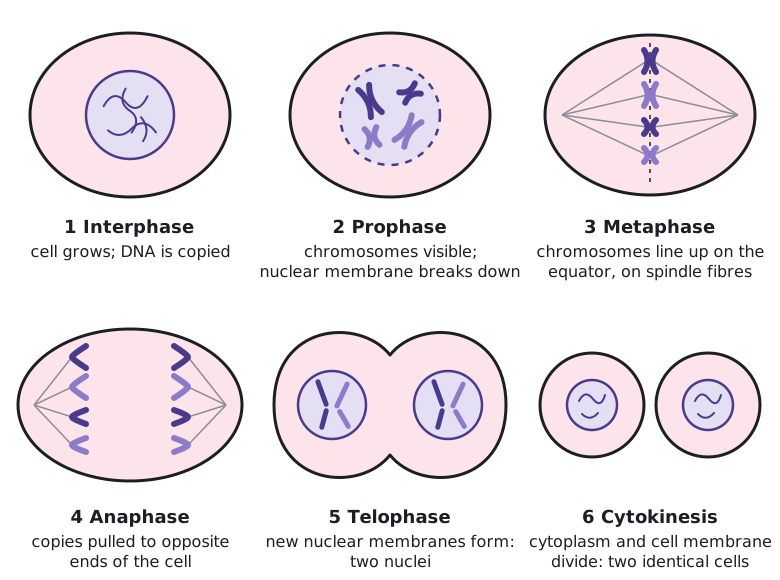 Tap to enlarge
What mitosis producesSpec 2.3
Mitosis produces two daughter cells. Each daughter cell has an identical set of chromosomes in its nucleus to the parent cell, so the two cells are genetically identical to the parent and to each other.
Body cells are diploid. This means the nucleus contains two sets of chromosomes, which form pairs. For example, human body cells have 46 chromosomes, arranged as 23 pairs. The DNA is copied in interphase and the copies are shared equally in mitosis, so each daughter cell also has 46 chromosomes.
- Daughter cell
- One of the two new cells produced when a parent cell divides.
- Diploid
- A cell with two sets of chromosomes in its nucleus.
- Genetically identical
- Having exactly the same genetic information (the same DNA).
Why mitosis is importantSpec 2.2
Mitosis is important in three ways.
- Growth: a multicellular organism grows by making more cells by mitosis. All the new cells are genetically identical, so they have the same instructions.
- Repair: damaged or worn-out cells are replaced with new cells made by mitosis, for example when skin is cut.
- Asexual reproduction: one parent produces offspring that are genetically identical to it. The offspring are made by mitosis, so there is no mixing of genetic information.
CancerSpec 2.4
Cell division is normally controlled, so a tissue makes only the cells it needs. Cancer is the result of changes in cells that lead to uncontrolled cell division.
The cells keep dividing by mitosis when they should not. This can form a mass of cells called a tumour.
Quick check
Put the stages of the cell cycle in order, starting with interphase.
Show answer
Interphase, prophase, metaphase, anaphase, telophase, cytokinesis.
What happens to the chromosomes in metaphase?
Show answer
They line up along the equator of the cell.
Name three uses of mitosis.
Show answer
Growth, repair and asexual reproduction.
What does diploid mean?
Show answer
The nucleus contains two sets of chromosomes, which form pairs.
What causes cancer?
Show answer
Changes in cells that lead to uncontrolled cell division.