

Alveoli and gas exchangeSpec 8.3
The lungs are the exchange surface for oxygen and carbon dioxide. Each lung contains millions of tiny air sacs called alveoli. Gases move between the air in the alveoli and the blood in the capillaries around them by diffusion.
- Oxygen diffuses from the air in the alveoli (high concentration) into the blood (low concentration).
- Carbon dioxide diffuses from the blood (high concentration) into the air in the alveoli (low concentration), and is breathed out.
| Adaptation | Why it helps |
|---|---|
| Millions of alveoli | Gives a very large surface area for diffusion |
| Walls only one cell thick | Short diffusion distance, so gases diffuse quickly |
| Capillary walls only one cell thick | Short diffusion distance between the air and the blood |
| Rich network of capillaries (good blood supply) | Blood carries oxygen away and brings carbon dioxide, keeping a steep concentration gradient |
| Moist lining | Gases dissolve, which helps them to diffuse |
| Ventilation (breathing in and out) | Keeps a high oxygen concentration in the alveoli and a low carbon dioxide concentration, which maintains the concentration gradient |
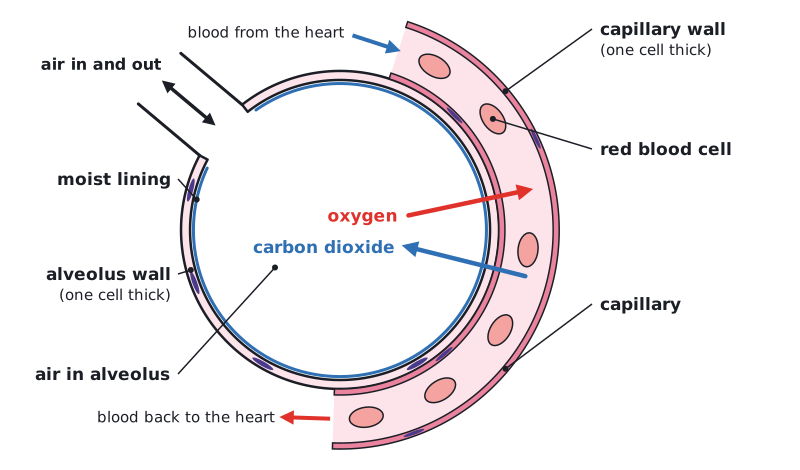 Tap to enlarge
Quick check
Why must urea be transported out of the body's cells?
Show answer
It is a waste product that is carried in the blood to the kidneys and removed in urine.
Does a large animal have a larger or smaller surface area : volume ratio than a single cell?
Show answer
Smaller.
Why do multicellular organisms need a transport system?
Show answer
Many cells are far from the surface, so diffusion alone is too slow to supply them.
State two ways alveoli are adapted for gas exchange.
Show answer
Any two of: large surface area, walls one cell thick, moist lining, good blood supply, ventilation.