

Fossil evidence for human evolutionSpec 4.4
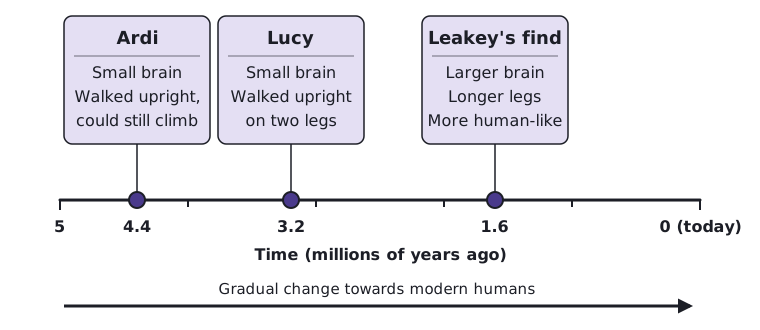
Fossils are the preserved remains or traces of organisms that lived long ago. By comparing fossils of different ages, scientists can see how early human ancestors changed over time. You need to know three important discoveries.
| Fossil | Age | What it shows |
|---|---|---|
| Ardi | 4.4 million years ago | Partial skeleton. A small brain and long arms. Could walk upright, but had a grasping big toe so could still climb trees. |
| Lucy | 3.2 million years ago | Partial skeleton. Walked upright on two legs, with feet more like a human's, but still a small brain and some ape-like features. |
| Fossils found by Richard Leakey and his team | 1.6 million years ago | Many fossils, including a nearly complete skeleton. A larger brain, longer legs and a body shape much more like a modern human. |
Taken together, the fossils show a gradual change from ape-like ancestors towards modern humans. Walking upright came first, and larger brains came later.
The evidence has limits. Fossils are rare because most dead organisms decay before fossilising, and many fossils are incomplete. This is why scientists sometimes disagree, and why new discoveries can change ideas about human evolution.
Working with large time spans
Ardi lived 4.4 million years ago and Lucy lived 3.2 million years ago. Write 4.4 million in standard form, and find how many years separate the two fossils.
- 4.4 million = 4 400 000 = 4.4 × 10⁶ years
- Difference = 4.4 − 3.2 = 1.2 million years
- 1.2 million = 1.2 × 10⁶ years
Answer: 4.4 × 10⁶ years; the fossils are 1.2 × 10⁶ years apart.
 Tap to enlarge