

Gregor MendelSpec 3.11BTriple only
Gregor Mendel was a monk who worked out the basis of genetics by breeding pea plants in the mid-1800s. He chose characteristics with clear alternatives, such as tall or short plants, and purple or white flowers.
- He crossed plants with different characteristics and counted the characteristics of the offspring over several generations.
- He found that characteristics are passed on as separate inherited factors, one from each parent. We now call these factors genes.
- He showed that some factors are dominant and others are recessive. For example, crossing pure-breeding tall plants with pure-breeding short plants gave all tall plants. Crossing those offspring with each other gave about three tall plants for every one short plant.
Difficulties before the mechanism was discovered
- Nobody knew about genes, DNA or chromosomes, so there was no mechanism to explain how characteristics are passed on.
- The behaviour of chromosomes during cell division and fertilisation had not been seen, so his ideas could not be linked to anything observable.
- His work was not recognised or understood at the time. It was only appreciated after the structures and processes involved in inheritance were discovered.
Alleles and inherited differencesSpec 3.12
Different forms of the same gene are called alleles. A gene for flower colour may have an allele for purple and an allele for white.
In body cells chromosomes are in pairs, so an organism usually has two alleles of each gene: one inherited from each parent. Individuals can have different combinations of alleles, so they have different inherited characteristics.
The alleles of a gene have slightly different base sequences, so they can code for slightly different versions of the same protein. This is why a difference in alleles can cause a difference in a characteristic.
Key genetic termsSpec 3.13
- Chromosome
- A long molecule of DNA in the nucleus that carries many genes.
- Gene
- A section of DNA that codes for a specific protein.
- Allele
- A different version of the same gene.
- Dominant
- An allele that is expressed in the phenotype even when only one copy is present.
- Recessive
- An allele that is only expressed in the phenotype when two copies are present (no dominant allele).
- Homozygous
- Having two identical alleles of a gene, for example TT or tt.
- Heterozygous
- Having two different alleles of a gene, for example Tt.
- Genotype
- The alleles an organism has for a gene (or genes).
- Phenotype
- The characteristics that are expressed and can be observed.
- Gamete
- A sex cell (such as a sperm or egg) with half the number of chromosomes.
- Zygote
- The cell formed when two gametes fuse at fertilisation.
Dominant alleles are written as capital letters (T) and recessive alleles as lower case (t). A heterozygous plant, Tt, shows the dominant characteristic.
Monohybrid inheritanceSpec 3.14
Monohybrid inheritance is the inheritance of a characteristic controlled by a single gene. You can show it using a genetic diagram, a Punnett square or a family pedigree.
- Choose letters for the alleles: a capital for dominant, lower case for recessive.
- Write the genotypes of the parents.
- Write the possible gametes from each parent. Each gamete has one allele.
- Combine the gametes in a Punnett square to show the possible genotypes of the offspring.
- Write the phenotype for each genotype.
Crossing two heterozygous pea plants
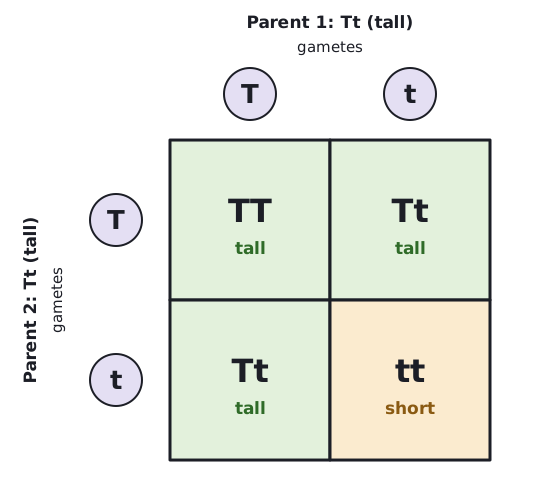
Tall (T) is dominant to short (t). Two heterozygous tall plants (Tt) are crossed. Show the possible offspring.
- Parent genotypes: Tt and Tt.
- Gametes: T or t from each parent.
- Punnett square: top row (gametes from parent 1) T and t; side column (gametes from parent 2) T and t. The four boxes are TT, Tt, Tt and tt.
- Phenotypes: TT, Tt and Tt are tall; tt is short.
Answer: Offspring genotypes: 1 TT : 2 Tt : 1 tt. Phenotypes: 3 tall : 1 short.
 Tap to enlarge
Family pedigrees
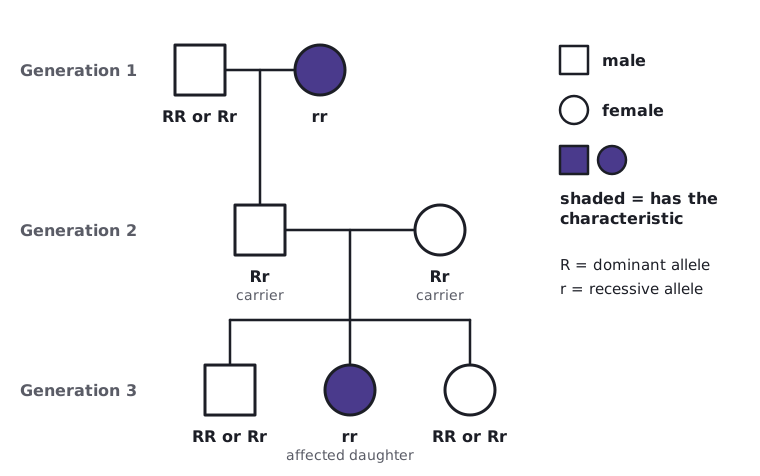
A family pedigree (family tree) shows who in a family has a characteristic. Squares are usually males and circles are females. Shaded shapes show people with the characteristic. A horizontal line joins the parents and a vertical line leads down to their children.
- If two parents who do not have a characteristic have a child who does, the characteristic is recessive. Both parents must be carriers, heterozygous with one copy of the recessive allele.
- If two parents who both have a characteristic have a child who does not, the characteristic is dominant. Both parents must be heterozygous.
 Tap to enlarge
Sex determinationSpec 3.15
Humans have 23 pairs of chromosomes. One pair is the sex chromosomes. Females have two X chromosomes (XX). Males have one X and one Y chromosome (XY).
All eggs carry an X chromosome. Half of the sperm carry an X and half carry a Y. The sex of the offspring is decided at fertilisation by which sperm fertilises the egg.
| X (egg) | X (egg) | |
|---|---|---|
| X (sperm) | XX female | XX female |
| Y (sperm) | XY male | XY male |
Two outcomes are female and two are male, so the ratio is 1 : 1 and there is a 50% probability that a baby will be a boy or a girl.
Calculating and analysing outcomesSpec 3.16
You need to calculate and analyse the outcomes of monohybrid crosses and pedigrees for dominant and recessive traits. Outcomes can be given as a ratio, a probability or a percentage.
| Outcome | Boxes out of 4 | Probability | Percentage |
|---|---|---|---|
| Short plant (tt) | 1 | 1/4 or 0.25 | 25% |
| Tall plant (TT or Tt) | 3 | 3/4 or 0.75 | 75% |
As a ratio, this is 3 tall : 1 short. A 3 : 1 ratio means 1 in 4 offspring are short, not 1 in 3.
Probability for a recessive disorder
A disorder is caused by a recessive allele (f). Two parents do not have the disorder but both are carriers (Ff). What is the probability that their child has the disorder?
- Gametes from each parent: F or f.
- Possible offspring: FF, Ff, Ff and ff.
- Only ff has the disorder. That is 1 out of 4 equally likely outcomes.
Answer: Probability = 1/4 = 0.25 = 25%.
Each child is an independent event. If the first child has the disorder, the probability for the next child is still 1 in 4. Probabilities describe chance. They do not guarantee the actual numbers in a family.
ABO blood groupsSpec 3.17BTriple only
The ABO blood group is controlled by a single gene with multiple alleles: more than two alleles of the same gene. There are three alleles, written here as IA, IB and IO. A person inherits two, one from each parent.
IA and IB are codominant: if both are present, both are expressed in the phenotype. IO is recessive to both.
| Phenotype (blood group) | Possible genotypes |
|---|---|
| A | IA IA or IA IO |
| B | IB IB or IB IO |
| AB | IA IB |
| O | IO IO |
Parents with group A and group B
A mother is IA IO and a father is IB IO. What blood groups could their children have?
- Mother's gametes: IA or IO. Father's gametes: IB or IO.
- Possible children: IA IB, IA IO, IB IO and IO IO.
Answer: Group AB, A, B and O, each with a 1 in 4 (25%) probability.
Sex-linked genetic disordersSpec 3.18BTriple onlyHigher tier
A sex-linked genetic disorder is caused by an allele on a sex chromosome. Most are caused by a recessive allele on the X chromosome. Haemophilia is an example.
- Males (XY) have only one X chromosome, so one copy of the recessive allele is enough to cause the disorder. The Y chromosome does not carry a matching allele.
- Females (XX) have two X chromosomes. They need two copies of the recessive allele to have the disorder. With one copy they are carriers.
- This is why sex-linked disorders are more common in males.
| XH (egg) | Xh (egg) | |
|---|---|---|
| XH (sperm) | XHXH unaffected female | XHXh carrier female |
| Y (sperm) | XHY unaffected male | XhY affected male |
Here XH is an X chromosome carrying the dominant normal allele (H) and Xh is an X chromosome carrying the recessive allele for haemophilia (h). The probability that a son has haemophilia is 50%. No daughters are affected, but half are carriers. An affected father passes his X to every daughter and his Y to every son, so his sons do not inherit the disorder from him.
Quick check
What is an allele?
Show answer
A different version of the same gene.
What is the difference between genotype and phenotype?
Show answer
Genotype is the alleles an organism has. Phenotype is the observable characteristic that is expressed.
Which sex chromosomes do human females and males have?
Show answer
Females XX, males XY.
Two parents without a disorder have an affected child. Is the allele dominant or recessive?
Show answer
Recessive, and both parents are carriers.
What is codominance?
Show answer
Both alleles are expressed in the phenotype when both are present, as with IA and IB giving blood group AB.