

What is genetic engineering?Spec 4.10
Genetic engineering is a process which involves modifying the genome of an organism to introduce desirable characteristics.
Usually a gene for the characteristic is taken from one organism and inserted into another organism of a different species. The organism produced is called a genetically modified (GM) organism. It can now make the protein coded for by the new gene.
| Organism | Gene inserted | Desirable characteristic |
|---|---|---|
| Bacteria | Human gene for insulin | Bacteria make human insulin, to treat diabetes |
| Crop plants | Gene for resistance to insect pests | Plants are not damaged by the pest |
The main stages of genetic engineeringSpec 4.11Higher tier
- The gene for the desired characteristic is cut out of the chromosome of the donor organism using a restriction enzyme. Each restriction enzyme cuts DNA at a specific sequence of bases.
- The cut leaves short, unpaired strands of DNA at each end. These are called sticky ends.
- The vector is cut open using the same restriction enzyme, so it has matching sticky ends. A vector is something used to carry the gene into the new cell, such as a bacterial plasmid or a virus.
- The gene and the vector are mixed. The sticky ends join by complementary base pairing, and the enzyme ligase joins the DNA strands together permanently. This makes recombinant DNA, for example a recombinant plasmid.
- The vector is used to insert the gene into the cells of the target organism (for example a bacterium, or a plant or animal at an early stage of development). The organism's cells now make the protein.
- Restriction enzyme
- An enzyme that cuts DNA at a specific base sequence.
- Sticky ends
- Short, unpaired strands of DNA left at the ends of a cut, which can join with complementary sticky ends.
- Ligase
- An enzyme that joins pieces of DNA together.
- Vector
- A carrier, such as a plasmid or virus, used to insert a gene into another organism's cells.
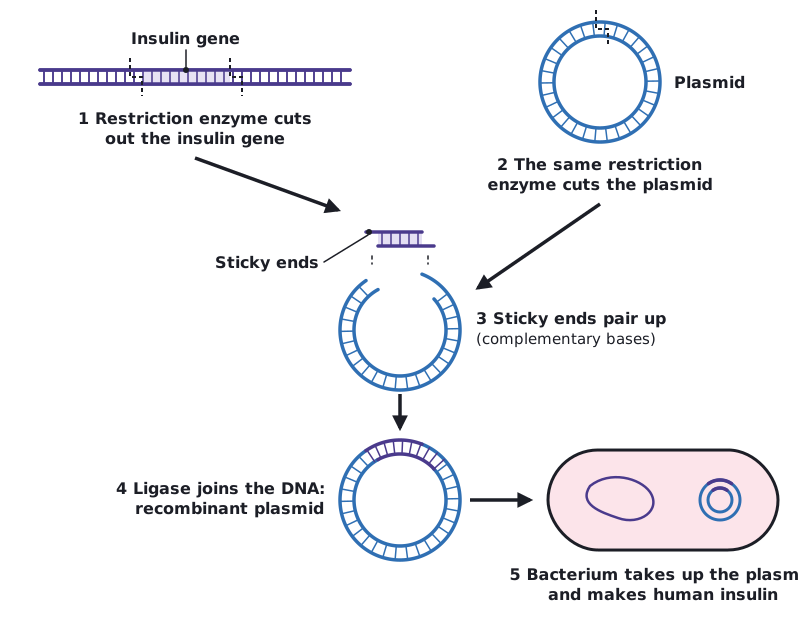 Tap to enlarge
GM organisms and crop plantsSpec 4.12BTriple only
A well-known example is the introduction of a gene from the bacterium Bacillus thuringiensis (Bt) into crop plants. The gene codes for a toxin that kills many insect pests. Plants with the gene make the toxin themselves and so have insect resistance.
| Advantages | Disadvantages |
|---|---|
| Less crop is lost to pests, so yields are higher | Possible risk to human health, which some people worry about |
| Less insecticide needs to be sprayed, which saves money and reduces damage to other organisms | Genes may spread to wild plants, and the toxin might harm other insects |
| Crops can be given extra characteristics, such as greater nutritional value or resistance to disease | GM seeds can be expensive, and farmers may have to buy new seeds each year |
| More food can be produced for a growing population | Concerns that it is wrong or unnatural to change organisms' genes |
| Crops with a gene for herbicide resistance can be sprayed to kill weeds without harming the crop | Insect pests may evolve resistance to the Bt toxin by natural selection |
Quick check
What is genetic engineering?
Show answer
Modifying the genome of an organism to introduce desirable characteristics.
What does a GM organism contain that a normal organism does not?
Show answer
A gene transferred from another organism.
Give one example of a desirable characteristic introduced by genetic engineering.
Show answer
For example, bacteria making human insulin, or crop plants resistant to insects.