

Growth in animals and plantsSpec 2.5
Growth is an increase in the size or mass of an organism. It involves different processes in animals and plants.
| Animals | Plants | |
|---|---|---|
| Cell division | Yes, by mitosis | Yes, by mitosis |
| Differentiation | Yes | Yes |
| Elongation | No | Yes: cells get longer |
In animals, growth happens by cell division and differentiation. New cells are made by mitosis and then become specialised for particular jobs.
In plants, growth happens by cell division, elongation and differentiation. Cells made by mitosis then get longer (elongate), mostly by taking in water so that the cell expands. After elongating, they differentiate. Elongation is what makes plants grow taller and roots grow longer.
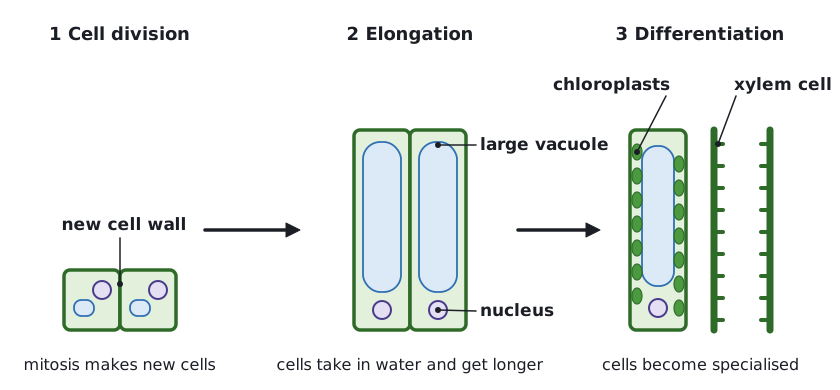 Tap to enlarge
Cell differentiationSpec 2.6
Differentiation is the process by which a cell becomes specialised for a particular job. The cell gains the sub-cellular structures it needs to carry out its function. For example, a nerve cell has a long axon, and a root hair cell has a long projection that gives a large surface area.
Differentiation is important in the development of specialised cells because a multicellular organism needs many different cell types doing different jobs. Specialised cells form tissues, which make up organs. Each type of cell can carry out its job efficiently.
Percentile chartsSpec 2.7
A percentile chart is used to monitor the growth of a baby or child. It shows curves for the measurements of a large number of children of the same age and sex, such as mass. A child's measurement is plotted on the chart.
- The 50th percentile line means 50% of children have a lower value and 50% have a higher value.
- A child on the 25th percentile has a value higher than 25% of children and lower than 75% of children.
- Plotting a child's measurements over time shows whether they follow a curve or move across to a different one. A large change may need to be investigated.
The chart is a graph. Use it to turn a number into a percentile, or the reverse.
Percentage gain in mass
A baby has a mass of 3.2 kg at birth and 4.0 kg at 8 weeks. Calculate the percentage gain in mass.
- change in mass = 4.0 − 3.2 = 0.8 kg
- percentage gain = 0.8 ÷ 3.2 × 100
Answer: 25%
Stem cells and meristemsSpec 2.8
A stem cell is an undifferentiated cell. It can divide to make more cells and can differentiate to become specialised cells.
| Type | Function |
|---|---|
| Embryonic stem cells | Found in early embryos. They can differentiate into any type of cell, so they produce all the specialised cells as the embryo develops. |
| Stem cells in animals (adult stem cells) | Found in some tissues, such as bone marrow. They can differentiate into only a limited range of cell types. They replace cells that are damaged or worn out, for example bone marrow makes new blood cells. |
| Meristems in plants | Found at the tips of roots and shoots. The cells divide and can differentiate into any type of plant cell, so the plant can keep growing throughout its life. |
Stem cells in medicineSpec 2.9
Stem cells may be able to replace damaged or diseased cells. Some potential uses are treating conditions such as diabetes and paralysis, and replacing damaged tissue.
| Benefits | Risks |
|---|---|
| Could treat conditions that are currently hard to treat, such as diabetes or paralysis. | Stem cells can divide out of control and form a tumour. |
| Could replace damaged cells with new healthy cells. | Viruses in donated stem cells could be passed to the patient and cause disease. |
| Could be used to grow replacement tissues. | The patient's immune system may reject cells from another person. |
| Some people object to using embryos for ethical or religious reasons. |
Quick check
Which process in plant growth does not happen in animals?
Show answer
Elongation (cells getting longer).
What does the 50th percentile mean?
Show answer
50% of children have a lower value and 50% have a higher value.
What is a stem cell?
Show answer
An undifferentiated cell that can divide and can differentiate into specialised cells.
What is the function of a meristem?
Show answer
Its cells divide and can differentiate into any type of plant cell, so the plant can keep growing throughout its life.
Give one risk of using stem cells in medicine.
Show answer
Any one of: tumour formation, viral infection from donor cells, immune rejection, ethical or religious objections.