
Water potentialSpec B3.2.4
In short
Osmosis is the net movement of water molecules from higher to lower water potential through a partially permeable membrane. Cambridge IGCSE Biology 3.2.
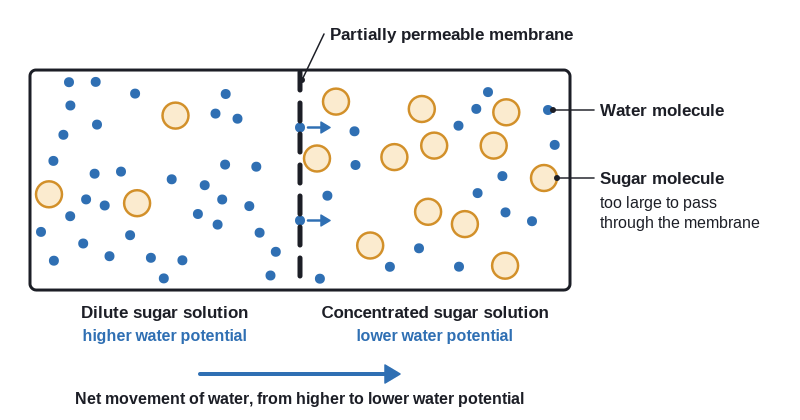
Water potential describes how freely water molecules can move. A dilute solution has a high water potential. A concentrated solution has a low water potential. Pure water has the highest water potential.
- Osmosis
- The net movement of water molecules from a region of higher water potential (dilute solution) to a region of lower water potential (concentrated solution), through a partially permeable membrane.
When a dilute sugar solution and a concentrated sugar solution are separated by a partially permeable membrane, the dilute solution has the higher water potential and the concentrated solution has the lower water potential. Water moves through the partially permeable membrane down this water potential gradient.
 (opens full size in a new tab)
Use the phrase 'water potential' and the word 'net'. Say 'from a higher water potential to a lower water potential', not 'from a weak solution to a strong solution' alone.
Written and checked against the Cambridge IGCSE Combined Science (0653) specification · Updated October 2026